this post was submitted on 04 Dec 2025
235 points (95.0% liked)
memes
18283 readers
1656 users here now
Community rules
1. Be civil
No trolling, bigotry or other insulting / annoying behaviour
2. No politics
This is non-politics community. For political memes please go to !politicalmemes@lemmy.world
3. No recent reposts
Check for reposts when posting a meme, you can only repost after 1 month
4. No bots
No bots without the express approval of the mods or the admins
5. No Spam/Ads/AI Slop
No advertisements or spam. This is an instance rule and the only way to live. We also consider AI slop to be spam in this community and is subject to removal.
A collection of some classic Lemmy memes for your enjoyment
Sister communities
founded 2 years ago
MODERATORS
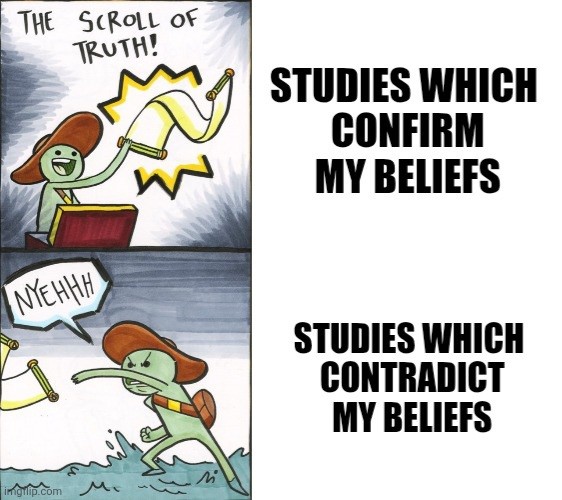
Funny meme, and natural part of human nature. But, while disregarding information that doesn't agree with your worldview can be bad, the reason it's a intrinsic bias is because most people are right about most things in their everyday life. If a stranger tells you that you owe them 20$, you're probably going to trust your gut that you don't, rather than start looking for evidence. Obviously, that breaks down when it's about anything abstract or complex, and there when we get science involved.
But if you're somewhat experienced and well read in a scientific area, you develop the same confidence in your understanding that leads you to dismiss some findings as unlikely. This can be bad, and one of things slowing scientific progress (see Planck's principle), but it's also a useful heuristic. If you've read enough economics papers, you develop a reasonable bullshit detector. Not that the research on the wealth tax you referred to is necessarily bad, but it's going to be using a model or drawing conclusions from some related data, in ways that (I suspect) would not convince me if I read it. Once you've read 30 articles showing that raising minimal wage cuts real spending power vs 30 that show it doesn't, you see how 'good economic research practice' can lead people to very different conclusions.
May as well reveal your interpretation of the 30 studies at this point. Not that you're wrong so far, more curious.
My conclusion was that raising minimum wage gave people more money to spend (obvs), and although it could be linked to some increase in inflation, that that cost was borne over the wider economy, so those on MW still saw an meaningful increase in real terms spending power. The evidence for MW rises causing unemployment were mixed, but meta-regression analysis showed that there was significant publication bias in MW studies (preferring those that showed MW raised unemployment) and once that was accounted for, MW was neutral on unemployment. Apart, perhaps for a small effect on teenagers.
But it was a few years back that I had to look in to that, and the studies themselves are often focussed on data from decades earlier. And that's the problem with a lot of economic research claims, while it is helpful to examine historical patterns and learn from them, it isn't easy to isolate the confounding factors and get to some general law. I feel it's closer to history than physics (despite the aspirations of some economists), you can learn from the past, but current society will be different in significant ways that might make things play out quite differently.