this post was submitted on 07 May 2026
1153 points (99.1% liked)
Fuck AI
7560 readers
766 users here now
"We did it, Patrick! We made a technological breakthrough!"
A place for all those who loathe AI to discuss things, post articles, and ridicule the AI hype. Proud supporter of working people. And proud booer of SXSW 2024.
AI, in this case, refers to LLMs, GPT technology, and anything listed as "AI" meant to increase market valuations.
founded 2 years ago
MODERATORS
you are viewing a single comment's thread
view the rest of the comments
view the rest of the comments
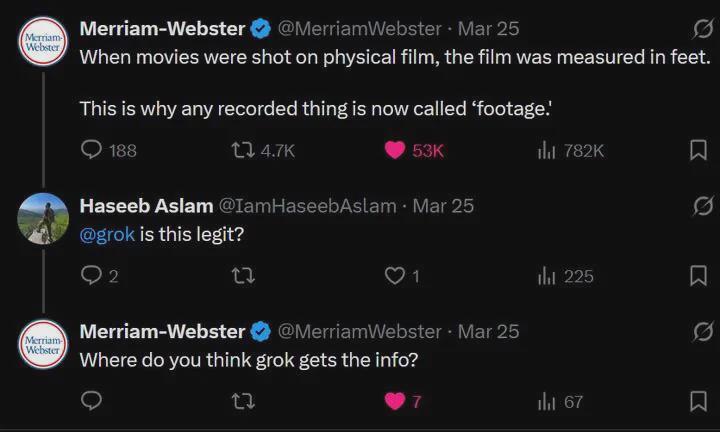
Here's a fun fact: photography predates film (duh) but the 35mm standard for photography came decades after the 35mm film standard.
Photos were originally taken on plates until Eastman figured out how to put em on a roll. Thomas Edison immediately used this to make one of those early strobe things I forgot the name of. Not long after, they standardized the design. And then wayyyy later, Kodak released 135 film for photography.
Bonus fact: Both capture the same 35x24mm image but they're physically different sizes because they're captured in different orientations.
Hooray, now I can say I used my college degree this month!
Stroboscope
I wound up looking it up and forgot to go back and edit, he called it the Kinetiscope
Oh shit, that's the other word I couldn't think of! I knew stroboscope sounded too easy
If I was him, I would have gone with strobulator.
Sorta!
So, yes, a 35mm still camera like most of us milennials' baby pictures were taken with does use the same film stock as a 35mm movie camera. The film is 35mm in overall width, but some of that is taken up with the two rows of sprocket holes.
A normal still camera feeds the film horizontally, and takes a 24x36 mm landscape frame. There are half-frame cameras that, in the same form factor, produce 24x16mm images. On the film, two images take up the same amount of space as a single "normal" image, with a border in between. It's a little confusing in that, you hold the device in landscape orientation and it shoots a portrait orientation.
Movie film is fed vertically, and you can do an entire lecture on the different aspect ratios it's captured at. The film in the camera and the film in the projector may actually be different. Part of the reason is audio. Motion picture cameras don't actually capture audio, that's a separate team's job, and we have about a century worth of different technology to send audio with the film to the projector. A typical movie will use a strip on the left side for optical audio, allowing 22x16mm for the image. The image is distorted to be narrower than it should be, and is projected through a lens to widen it back out during projection. There are other permutations to use more or less of the film stock through various means, but that's the most common standard.
There's like eight ways to do audio; I mentioned the continuous analog optical track recorded to the immediate left of the frame. You may also find digital audio recorded on the edge outside the sprocket holes, or Dolby digital audio recorded in between the sprocket holes. Or, a digital timecode on the film allows multi-track digital audio stored on optical discs to be synchronized with the projected image. Many film prints include multiples of these technologies because the publisher might not be sure what audio equipment the theater has; You want to be able to play Avengers Versus Lord Of The Rings XVII: This Time It's Personal in an independent cinema with a projector made in 1970 and at least get analog stereo out of it.
Very cool, and fun