586
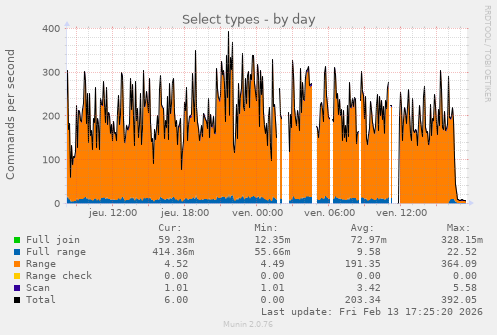
Based on this graph, and this graph alone, guess at what time I completely blocked OpenAI crawlers
(jlai.lu)
I really hope they die soon, this is unbearable…
A place to share alternatives to popular online services that can be self-hosted without giving up privacy or locking you into a service you don't control.
Rules:
Be civil.
No spam.
Posts are to be related to self-hosting.
Don't duplicate the full text of your blog or readme if you're providing a link.
Submission headline should match the article title.
No trolling.
Promotion posts require active participation, with an account that is at least 30 days old. F/LOSS without a paywall has exceptions, with requirements. See the rules link for details. Tags [CBH] or [AIP] are required, see the links in Rule 8 for details.
AI-related discussions and AI-involved promotional posts have additional requirements for tagging, as noted in Rule 7 and the AI & Promotional Post Expanded Rules post, and find example disclosures here.
Resources:
Any issues on the community? Report it using the report flag.
Questions? DM the mods!
I really hope they die soon, this is unbearable…
I’m providing hosting for a few FOSS services, relatively small scale, for around 7 years now and always thought the same for most of that time. People were complaining about their servers being hit but my traffic was alright and the server seemed bulky enough to have a lot of buffer.
Then, like a month or two ago, ~~the fire nation attacked~~ the bots came crawling. I had sudden traffic spikes of up to 1000x, memory was hogged and the CPU could barely keep up. The worst was the git forge, public repos with bots just continuously hammering away at diffs between random commits, repeatedly building out history graphs for different branches and so on - all fairly intense operations.
After the server went to its knees multiple times over a couple days I had to block public access. Only with proof of work in front could I finally open it again without destroying service uptime. And even weeks later, they were still trying to get at different project diffs whose links they collected earlier, it was honestly crazy.
That’s very interesting, as if only certain types of content get crawled. May I know what kind of software you used and if you had a reverse proxy in front of it?
The code forge is gitea/forgejo, and the proxy in front used to be traefik. I tried fail2ban in front for a while as well but the issue was that everything appeared to come from different IPs.
The bots were also hitting my other public services pretty hard but nowhere near as bad. I think it’s a combination of 2 things:
A small interesting observation I made was that they also seemed to ‘focus’ on specific projects. So my guess would be you get unlucky once by having a large-ish repo targeted for crawling and then they just get stuck in there and get lost in the maze of possible pages. On the other hand it may make targeted blocking for certain routes more feasible…
I think there’s a lot to be gained here by everybody pooling their knowledge, but on the other hand it’s also an annoying topic and most selfhosting (including mine) is afaik done as a hobby, so most peeps will slap an Anubis-like PoW in front and call it a day.
Those are some very good and helpful insights, thank you very much for sharing. I was also hosting forgejo and used traefik as reverse proxy. However, my forgejo was locked down, which is probably why I had no bot attack.
Some thoughts: