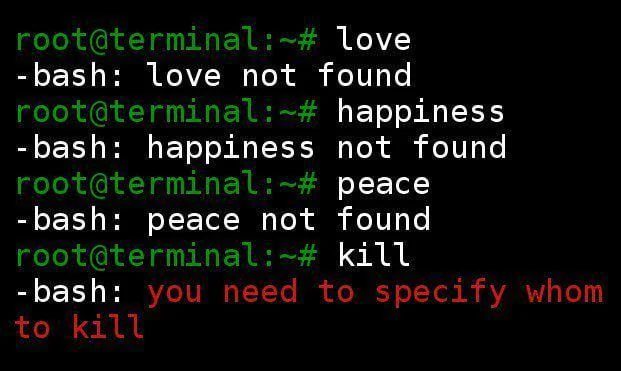
bash kill output:
kill: usage: kill [-s sigspec | -n signum | -sigspec] pid | jobspec ... or kill -l [sigspec]
fish kill output:
kill: not enough arguments
Hint: :q!
Sister communities:
Community rules (click to expand)
1. Follow the site-wide rules
sudo in Windows.Please report posts and comments that break these rules!
Important: never execute code or follow advice that you don't understand or can't verify, especially here. The word of the day is credibility. This is a meme community -- even the most helpful comments might just be shitposts that can damage your system. Be aware, be smart, don't remove France.
bash kill output:
kill: usage: kill [-s sigspec | -n signum | -sigspec] pid | jobspec ... or kill -l [sigspec]
fish kill output:
kill: not enough arguments
touch pp
touch cat
man date
man mount
That caught me off guard
And this is why Linux needs age verification! Won't somebody please think of the children?!
Actually, maybe it would be better, if certain people thought of the children less.
More is less.
Peace was never an option.
Crazy mode activated.
Have you heard about Our Lord and Savior: Jesux
Also, we are seriously considering changing some fundamental OS features. The idea would be that function calls and features suggesting evil and otherwise pagan ideas would be changed.
abort(3)
kill(1)
references to "daemon"
The problem of linux getting in the wrong hands:
$ touch gir*
bash: glob did no match any file. Did you mean young woman?
kill is a command.
love, happiness, and peace are not commands.
You can totally find love using command sudo apt install love. It's a game engine.
happiness is a Perl module inside libdemeter-perl package. Let's not install Perl modules, there lies insanity.
And you can find peace in a whole bunch of packages, it's an icon of the peace symbol.
All you need is kill
su - AlGreen
kill ALL
We can get them for you wholesale.
forced consent
$ no
bash: no: command not found
$ yes
y
y
y
y
y
...
$ yes n
n
n
n
n
n
n
...
I kind of want to go back in time and make it so that the original yes always printed the first letter of the name it was called by. That way you could symlink any name you like to it and it would do the right thing. Called as no it would print ns, etc. The optional parameter would still be there for longer strings or alternate uses.
The reason time travel would be needed is that there's bound to be, or have been, someone who has done something weird regarding symlinking yes that relies on it always printing y when it has no parameter, and the name trick would be a breaking change.
yesn't
Or make your own package? call it affirm (more wholesome), write it in Rust (of course), and take on yes.
Ha! On Ubuntu, the OS of Love, you get:
manxu@ubuntu:~ love
Command 'love' not found, but can be installed with:
sudo snap install love  # version 11.2+pkg-d332, or
sudo apt  install love  # version 11.4-1
See 'snap info love' for additional versions.