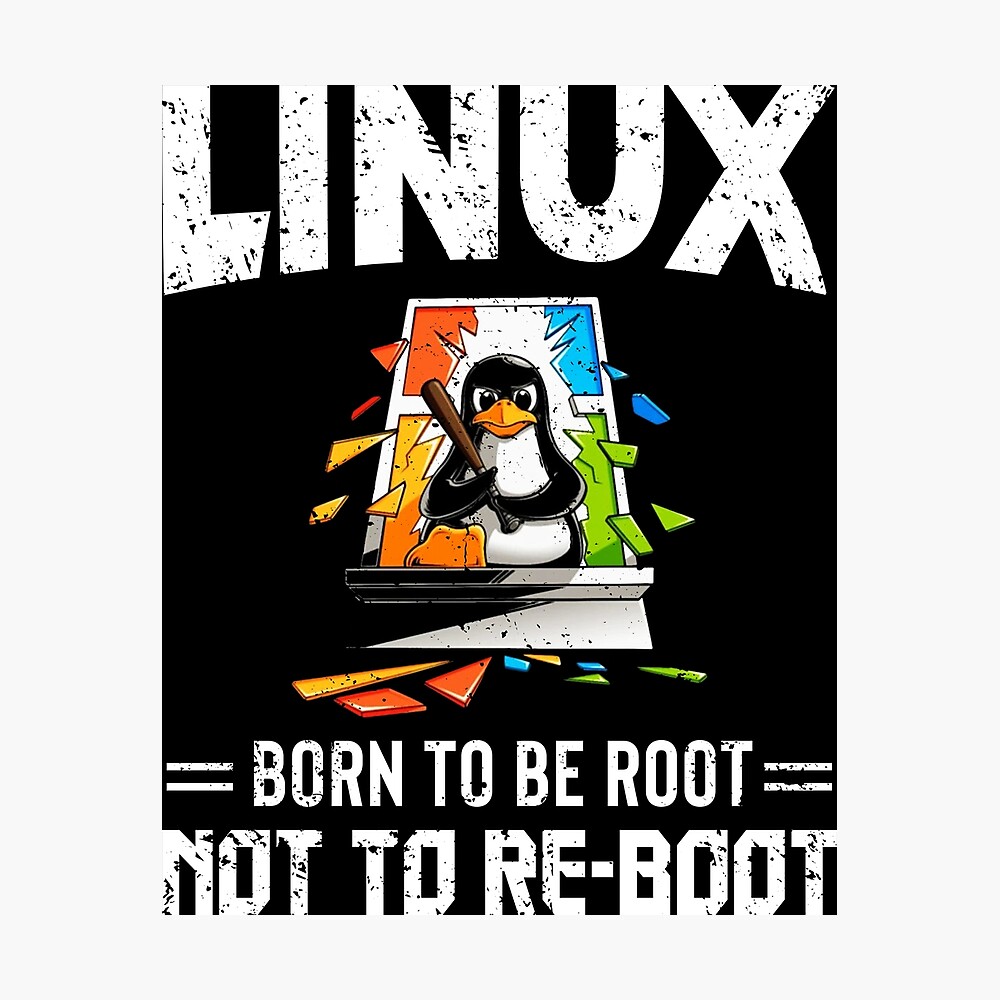
I can't find the original image but here's a decent one someone posted somewhere else lol:

Hint: :q!
Sister communities:
Community rules (click to expand)
1. Follow the site-wide rules
sudo in Windows.Please report posts and comments that break these rules!
Important: never execute code or follow advice that you don't understand or can't verify, especially here. The word of the day is credibility. This is a meme community -- even the most helpful comments might just be shitposts that can damage your system. Be aware, be smart, don't remove France.
I can't find the original image but here's a decent one someone posted somewhere else lol:
I.mean, I love Linux but I do need to reboot often.
I don't need to reboot, I can leave it on however long I want. I just don't want to figure out which services need restarting, so they all get restarted.
Don't forget to restart the kernal
yeah, same :')
Sick! We need more Linux stickers.
Excellent. Where can I get these stickers?
No idea unfortunately
Officially, I'm not sure.
But Linux is open source, so you can just print out the image above and slap some double sided tape on it...
Bonus points if you straighten out the mild trapezoid distortion and maybe apply a little contrast on it using GIMP. 🐧
The fact that the Linux source code license is open doesn't give permission to another work about Linux.
An analogy would be a park - you can use it, go running, etc with no issues. But if you setup your easel and make a painting of the park, that painting is an original creative work, and it is protected under copyright laws.
The same for that sticker. Even with the image of Tux being made "free" (attribution) by its creator, this stylized combination of drawing and text is still copyrighted, so we'd have to ask their permission for the stickers.
Seems like some made it on a t-shirt, although it probably comes from irc or a forum I guess.
Cool, but to be fair Linux is made to not make you root.
In most cases a sysadmin somewhere is root, and you may only pledge to him by email and wait weeks for when he decides you waited long enough for a reply.
User permissions are quite strict in Linux.
I'm still pissed there is no way for a user to decide to open a shared folder to other users which enforces base permissions without root doing that.
I'm still pissed there is no way for a user to decide to open a shared folder to other users which enforces base permissions without root doing that.
can't you?
you can assign a preexisting group to a folder as a secondary owner. or you can do it per-user with ACLs
Tried ACL, it kind of works. However users first respect the creation umask, which is generally 022. Which means they can create files in my directory but I can not delete them.
You can force everyone working with you to set their umask to 000, which clearly is not a really nice solution. However, even this does not solve the problem, since if they copy anything over which does not have 666 permissions then you can not edit it or delete it.
Then you're stuck with a bunch of files by someone else who left you their things that you can not delete.
I still have 1 TB of stuff somewhere from a user which has long been deleted from the system, I have no other way to delete that stuff than contact the system administrator.
You can assign a group and then set permissions to 660 and do some ACL magic which hopefully works to enforce a umask of 0 on group; however you can not create a group without being root, which does not really solve the problem.
To be fair, I would appreciate if users were allowed to create their own groups.
did you try setting the default ACL on the shared directory?
section "OBJECT CREATION AND DEFAULT ACLs" here: https://linux.die.net/man/5/acl
I'm not quite sure about how does the inheritance of the default work though. but initially you will need to set the default ACL recursively, so that all existing directories will have the proper default ACL
Mind you, on my own Linux machine I can become root while on Windows all I can be is someone with admin rights (but subordinate to SYSTEM).
Yea, it's a completely different security model, due to coming from Unix (a multi-user system) while Windows started as a single-user system.
Windows is user-centric security, Linux is file/process-centric.
Linux is arguably better, but it also requires more management.
I don't understand people who don't turn off the computers. Like why does it need to be on when you're not using it. Linux boots up almost instantly nowadays. And you can save your session so everything is exactly where you left it if that's what you're worried about
Woah, what about your uptime? Gotta pump up those numbers!
My longest running machine at the moment:
00:31:08 up 378 days, 5:12, load average: 0.00, 0.00, 0.00
My old raspberry pi 1b, which I use as an audio server for my stereo receiver. I typically have 4-5 machines running at any time performing various network-related tasks. I keep user terminals up as well, if they don't consume much (<=10w). GPU hogs get put to sleep.
Because I fail to configure wake-on-lan and such and I sometimes want remote access to it. I do have cron put it to sleep in low-hours and wake up next day...
Your toilet has a door? Mine uses a lid
I read this in Arnold Schwarzenegger's voice.
Is this a dig at the current minor Gnome 50 drama with the Log-Out button..?
Do tell. What's this drama?
The TL;DR I remember is that over a decade ago, someone who works on Gnome has decided that a machine with only a single user and a single DE does not need to have a "Log Out" button by default - when people mentioned that logging out of a user is still useful to reload settings, the response was that "just rebooting is fine in that case". Thing is, no one actually noticed those changes until now, because with the X11/Wayland switch, every environment was technically running two DEs and had the logout button. But now with Gnome 50, the switch was completed and the Logout button disappeared for many people (as technically intended, but that feature was implemented so long ago that even a lot of current Gnome devs were confused by it)
Lol. Typical Gnome fuckery. What a bunch of fuckwits.
I stopped using it 20 or 25 years ago because of stuff like this, and they keep doing it, release after release. I've no idea why users put up with it.
I want that on a T-shirt
Have I got great news for you.
How legit is this site? Considering the purchase. Lol
there was a bot pandemic on reddit several years ago. where when people commented "I want this on a shirt" and similar phrase, bots will reply with random links selling shirts with somehow that exact design appear on the reddit post.
nowadays it still gives me redflag vibes when someone ask such question about design & t-shirt and replied with a link 💀
Not a bot, I swear.
I was looking for the sticker for myself, and only found the redbubble shirts. Strangely, the "designer" only put it on shirts - typically redbubble people will slap their shit on everything - mousepads, mugs, shirts, sweaters, you name it.
I see! I apologize for assuming you a bot
Meh? Redbubble is very adequate for things like this. The shirts aren't super great quality - but if you really want the shirt badly, they have shipped shirts and mugs to me in the past.
Just be real careful washing (cold, delicate, and inside out) and for the love of God hang to dry.
Ironic. Most Linux desktop distros now don't set up a root password, and they make you reboot after many updates.
Make you reboot? More like "suggest a reboot", and not after "many updates" bit after installing a new kernel or graphics drivers on a running graphical desktop environment. Typically, the latter can also be handled on the command line, and the reboot suggestion is for less tech savvy users
Make you reboot? More like “suggest a reboot”
They tell the user to reboot, and they don't phrase it like it is optional. It's been a while since I've used Ubuntu, for example, but my memory is that they say that a reboot is required, or something along those lines. There is nothing wrong with my using the phrase "make you reboot" for those cases.
not after “many updates” bit after installing a new kernel or graphics drivers on a running graphical desktop environment.
When I was using Ubuntu, I'd get a reboot request like once every couple of weeks to a month. Maybe you don't think that's "many updates", but the point of the sticker was obviously to compare to other operating systems, and in that regard, it was similar to Windows, probably more frequent.
Ok two things here: