this post was submitted on 25 Jun 2026
982 points (98.6% liked)
me_irl
7959 readers
2010 users here now
All posts need to have the same title: me_irl it is allowed to use an emoji instead of the underscore _
founded 3 years ago
MODERATORS
you are viewing a single comment's thread
view the rest of the comments
view the rest of the comments
I had a conversation about The Phantom Menace about how Anakin and Shmi live in a multi-room dwelling by themselves, are given time off, and have enough free time and resources for Anakin to build a protocol droid and multiple pod racers (remember: it's said that he's never finished a race, so either his earlier racers broke down mid-race and had to get towed or else were wrecked).
How does this lifestyle comport with them being slaves?
Sure, they have explosive neck bolts and can be bought and sold, but their lifestyle seems rather outside of what we think of today as slavery.
My conclusion is that the Galaxy Far Far Away has a broader definition of slavery.
There's a few types of employment in the GFFA. There's self-employment and business ownership, like bounty hunting, running your own diner, playing in a band, or operating a cargo business that avoids Imperial entanglements.
There's employment within a military or paramilitary organization, like Grand Army of the Republic, the Empire, or the Jedi.
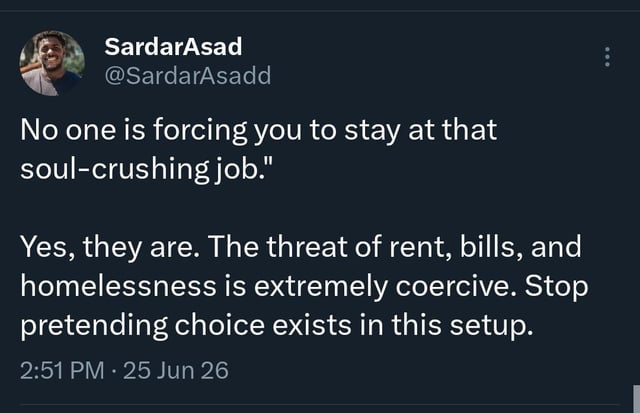
And then there's being a slave. You need to work for someone else or you die. Maybe you can or can't be literally sold. But you don't have a choice about the fact that you need employment or you will flat out die in the streets. If you aren't defining the terms of your own employment or you aren't earning rank in a military organization, then you are a slave, by the terms of the Star Wars galaxy.
Something I realized years ago.
There are many "dystopian" works of fiction where the characters actually get housing and enough food for their needs provided by the government free of charge in exchange for ideological compliance or at least pretending to. In these settings the government functions as a totalitarian entity micromanaging all aspects of existence, so the "freedom" to starve to death is effectively eradicated along with other freedoms.
By decoupling survival from labor market participation, or more accurately, by making the labor market an extension of the state, the system achieves a level of physiological stability that is undeniably attractive to anyone who has ever experienced the existential dread of housing insecurity or food scarcity in the current system.
In many dystopian settings, such as the works of Huxley and Orwell, the terror comes from the watchful eye of the state and the fear of punishment for deviation. In our current system, the terror comes from invisibility and abandonment, being ignored by a system that definitely has the resources and the means to feed you (roughly half the food produced today is being wasted) but refuses to do so unless you prove useful can definitely feel more dehumanizing and dystopian than being strictly micromanaged by an overbearing authority.