this post was submitted on 28 Sep 2026
530 points (95.5% liked)
Microblog Memes
12227 readers
3013 users here now
A place to share screenshots of Microblog posts, whether from Mastodon, tumblr, ~~Twitter~~ X, KBin, Threads or elsewhere.
Created as an evolution of White People Twitter and other tweet-capture subreddits.
RULES:
- Your post must be a screen capture of a microblog-type post that includes the UI of the site it came from, preferably also including the avatar and username of the original poster. Including relevant comments made to the original post is encouraged.
- Your post, included comments, or your title/comment should include some kind of commentary or remark on the subject of the screen capture. Your title must include at least one word relevant to your post.
- You are encouraged to provide a link back to the source of your screen capture in the body of your post.
- Current politics and news are allowed, but discouraged. There MUST be some kind of human commentary/reaction included (either by the original poster or you). Just news articles or headlines will be deleted.
- Doctored posts/images and AI are allowed, but discouraged. You MUST indicate this in your post (even if you didn't originally know). If an image is found to be fabricated or edited in any way and it is not properly labeled, it will be deleted.
- Absolutely no NSFL content.
- Be nice. Don't take anything personally. Take political debates to the appropriate communities. Take personal disagreements & arguments to private messages.
- No advertising, brand promotion, or guerrilla marketing.
RELATED COMMUNITIES:
founded 3 years ago
MODERATORS
you are viewing a single comment's thread
view the rest of the comments
view the rest of the comments
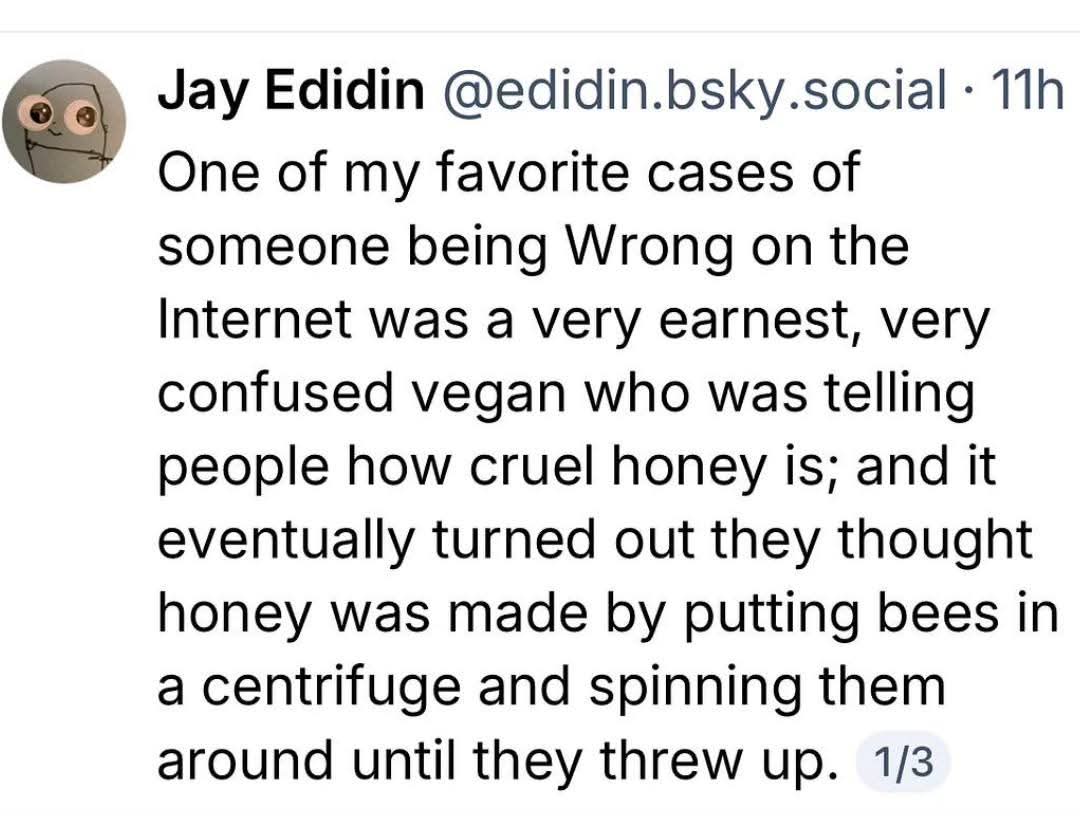
I'd say his heart was in the right place though as there are some good arguments against beekeeping. I don't want to be seen as brigading this post but I just want to inform those willing to learn about what environmental consequences the practise of beekeeping actually entails.
Beekeping is one of those things that people seem to consider as beneficial for the environment and naturally wholesome but the industry has a way of making sure people stay misinformed about its actual effects on the environment (as with any industry under capitalism). Beekeeping really is just another one of these things that vegans argue against for a good, albeit misunderstood reason, and it is a little jarring to see how misinformed people are about the subject.
Beekeeping is essentially worsening the insect/pollinator death spiral we have going on right now. Native insects and pollinators are diminishing due to many factors including deforestation, urbanisation, farming (toxic pesticides) and industry. Beekeeping is essentially worsening these issues since the bees start outcompeting the native pollinators. Natural pollinator diversity gets reduced into more of a monoculture as every single bee species that is used in beekeeping is closely related to each other. And since these bees have a natural preference for certain plants while ignoring others, and they lack specific behaviours that native pollinators display it disrupts ecosystems in unpredictable ways and worsens this already existing downwards spiral. Bees get important assistance from beekeepers that native pollinators don't get which also increases their ability to compete in environments they aren't necessarily suited for.
I'm not trying to demonize bees here, but I am sort of noticing that most people don't really know why vegans don't eat honey and I hope this info makes it more clear.
But don't we have a diminishing bee population so it's good to be supporting the bee population? But you're saying that it will upset the ecosystem if we only assist one species of natural pollinators
That'd be same as we are losing potatoes species so we should plant more potatoes. The issue is the wild/native variety is lot more various and different than the industrial potatoes we plant.
Or a more extreme case: we're losing wolves so let's breed more dogs.
Bees used for honey making is just a small fragment of bee species humans use. While the native bees are various,and have different patterns of living and polination
That's the confusing thing, right? But the honeybees that beekeepers manage aren't necessarily the same bee species that live natively in that area. The european honeybee is the most common bee species to keep because we know how to handle them and how to extract more honey from them. When these bees are introduced to an ecosystem they start competing with already existing pollinators, including native bees that may have different behaviours including preferences for plants, they can have different predators and can impact ecosystems in ways that are different to predict.
The best way to actually help the native bees from my understanding is to stop warming the climate, leave certain parts of nature wild and native (seeding native plants and rewilding) and reduce the use of toxic pesticides as these all contribute to the decline. Something that is toxic enough to potentially cause cancer or hurt humans can also hurt or immediately kill smaller creatures that don't have as complex immune systems as humans. The most common pesticides we currently use include effects like seizures, eye damage, organ failure, etc for humans and wildlife is continuously and repeatedly exposed to these substances as we cannot really tell them to stay away from farms and fields. Say one wild bee is out exploring in close proximity to an area that is freshly sprayed then brings it home to the hive.
There are all of these different political areas and systems that all affect nature. If you want to help make a positive impact then the most important part is to pick one place to put your energy so it doesn't get overwhelming. It is all complex and overwhelming for a reason.