cypherpunks

joined 4 years ago
MODERATOR OF
[–] cypherpunks@lemmy.ml 5 points 1 month ago

Use Ctrl-Z

followed by jobs, kill %1, etc

[–] cypherpunks@lemmy.ml 3 points 1 month ago (1 children)

Wow. Although I do still think it is written with some LLM assistance, and I don't think the authors sincerely believe the absurd alt-history they're espousing in this article, I am sad to say I think your assessment here is actually spot-on.

I got a slop vibe after reading just a little of it, and then clicked away and skimmed their other article titles ("Based International Law", "The GIGACHAD Approach", "Shitposting as a National Asset", etc). then clicked to the homepage and saw their "Generated Affairs" (thisforeignaffairsarticledoesnotexist.com) LLM thing under Special Projects, and I naively concluded that the whole thing was merely an edgelord trolling project.

Looking at it a little closer now (and seeing that their other link under Special Projects https://rickovercorpus.org/ is actually a serious thing which links back and thanks them for funding) I am also horrified.

I still think it is an edgelord trolling project, but it is one with a likelihood to be seriously influencing actually-powerful people 😱

[–] cypherpunks@lemmy.ml 3 points 1 month ago* (last edited 1 month ago) (3 children)

This is what the radical far right wing of the US establishment is thinking

No, it isn't. They are thinking and doing plenty of horrible things, but not what is on that website.

i didn't read very much of it because i don't suffer LLM outputs gladly, but to their credit at least the edgelords who created it were nice enough to put a troll face at the bottom to remove any doubts one might have about its lack of sincerity 🙄

Check their twitter and other projects if you still aren't sure, but after you realize what it is I hope you'll delete this post to stop spreading their slop.

[–] cypherpunks@lemmy.ml 31 points 1 month ago (8 children)
[–] cypherpunks@lemmy.ml 4 points 1 month ago* (last edited 1 month ago)

that little triangle means you need to click on the the text in the comment to read the rest of it, because it's wrapped in a spoiler tag. also fyi you can search twitter without a login using xcancel.com; it takes much less than 5 minutes to do so.

[–] cypherpunks@lemmy.ml 4 points 1 month ago* (last edited 1 month ago) (2 children)

I’m going to need you to drop a source that will take me less than five minutes to understand

that sounds like sealioning 🤡 but i'll bite, once:

are you asking for evidence that lunduke is queerphobic, or that the rust community has a disproportionate number of queer people in it?

or, do you acknowledge both of those things, and are actually suggesting that lunduke's vehement opposition to rust could maybe conceivably be entirely coincidental and perhaps he dislikes it for purely technical reasons? 😂

in any case, i'm not going to link to lunduke but i just checked and confirmed that (as i assumed) if you simply search his twitter for the word rust you can find many tweets (and i only went back a month) where he is in fact complaining about people being queer.

[–] cypherpunks@lemmy.ml 9 points 1 month ago (2 children)

just post it on lemmy world as a meme, copypaste a comment that makes the code better along with the original code into the AI agent

I'm curious if you succeeded with this approach here - have you gotten your LLM to produce a bash function which you can use without needing to understand how to specify an ffmpeg filename pattern yet?

btw, if want to try learning the old-fashioned way, have a look at man ffmpeg-formats where you can find perhaps-useful information like this:

   segment, stream_segment, ssegment
       Basic stream segmenter.

       This  muxer  outputs  streams  to  a number of separate files of nearly
       fixed duration. Output filename pattern can be set in a fashion similar
       to image2, or by using a "strftime" template if the strftime option  is
       enabled.

       "stream_segment"  is  a variant of the muxer used to write to streaming
       output formats, i.e. which  do  not  require  global  headers,  and  is
       recommended  for  outputting  e.g.  to  MPEG transport stream segments.
       "ssegment" is a shorter alias for "stream_segment".

       Every segment starts with a keyframe of the selected reference  stream,
       which is set through the reference_stream option.

       Note  that if you want accurate splitting for a video file, you need to
       make the input key frames  correspond  to  the  exact  splitting  times
       expected  by  the  segmenter,  or  the segment muxer will start the new
       segment with the key frame found next after the specified start time.

       The segment muxer works best with a single constant frame rate video.

       Optionally it can generate a list of the created segments,  by  setting
       the   option   segment_list.   The   list  type  is  specified  by  the
       segment_list_type option. The entry filenames in the segment  list  are
       set by default to the basename of the corresponding segment files.

       See  also  the hls muxer, which provides a more specific implementation
       for HLS segmentation.

       Options

       The segment muxer supports the following options:

[...]

From the image2 section, here is how the filename pattern works:

           sequence
               Select  a  sequence pattern type, used to specify a sequence of
               files indexed by sequential numbers.

               A sequence pattern may contain the string "%d" or "%0Nd", which
               specifies  the  position  of  the  characters  representing   a
               sequential  number  in each filename matched by the pattern. If
               the form "%d0Nd" is used, the string representing the number in
               each filename is 0-padded and N is the total number of 0-padded
               digits representing the number. The literal character  '%'  can
               be specified in the pattern with the string "%%".

               If  the  sequence  pattern  contains  "%d" or "%0Nd", the first
               filename of the file list specified by the pattern must contain
               a  number  inclusively  contained  between   start_number   and
               start_number+start_number_range-1,   and   all   the  following
               numbers must be sequential.

               For example the pattern "img-%03d.bmp" will match a sequence of
               filenames  of   the   form   img-001.bmp,   img-002.bmp,   ...,
               img-010.bmp,  etc.;  the  pattern "i%%m%%g-%d.jpg" will match a
               sequence of filenames of  the  form  i%m%g-1.jpg,  i%m%g-2.jpg,
               ..., i%m%g-10.jpg, etc.

And btw, the ffmpeg-formats manual does also include examples:

       Examples

       •   Remux the content of file in.mkv to a list of segments out-000.nut,
           out-001.nut, etc., and write the  list  of  generated  segments  to
           out.list:

                   ffmpeg -i in.mkv -codec hevc -flags +cgop -g 60 -map 0 -f segment -segment_list out.list out%03d.nut

       •   Segment  input  and  set  output  format  options  for  the  output
           segments:

                   ffmpeg -i in.mkv -f segment -segment_time 10 -segment_format_options movflags=+faststart out%03d.mp4

       •   Segment the input file according to the split points  specified  by
           the segment_times option:

                   ffmpeg -i in.mkv -codec copy -map 0 -f segment -segment_list out.csv -segment_times 1,2,3,5,8,13,21 out%03d.nut

       •   Use  the  ffmpeg force_key_frames option to force key frames in the
           input at the specified location, together with the  segment  option
           segment_time_delta  to account for possible roundings operated when
           setting key frame times.

                   ffmpeg -i in.mkv -force_key_frames 1,2,3,5,8,13,21 -codec:v mpeg4 -codec:a pcm_s16le -map 0 \
                   -f segment -segment_list out.csv -segment_times 1,2,3,5,8,13,21 -segment_time_delta 0.05 out%03d.nut

           In order to force key frames on  the  input  file,  transcoding  is
           required.

       •   Segment the input file by splitting the input file according to the
           frame numbers sequence specified with the segment_frames option:

                   ffmpeg -i in.mkv -codec copy -map 0 -f segment -segment_list out.csv -segment_frames 100,200,300,500,800 out%03d.nut

       •   Convert  the  in.mkv  to  TS segments using the "libx264" and "aac"
           encoders:

                   ffmpeg -i in.mkv -map 0 -codec:v libx264 -codec:a aac -f ssegment -segment_list out.list out%03d.ts

       •   Segment the input file, and create an M3U8 live  playlist  (can  be
           used as live HLS source):

                   ffmpeg -re -i in.mkv -codec copy -map 0 -f segment -segment_list playlist.m3u8 \
                   -segment_list_flags +live -segment_time 10 out%03d.mkv

It is actually possible to figure out how to do this and many other ffmpeg tasks even without internet access :)

[–] cypherpunks@lemmy.ml 16 points 1 month ago* (last edited 1 month ago) (7 children)

it's not obvious but, i'm pretty sure this meme (and its creator's vehement opposition to rust) is in fact substantially motivated by queerphobia.

[–] cypherpunks@lemmy.ml 27 points 1 month ago (2 children)
[–] cypherpunks@lemmy.ml 27 points 2 months ago* (last edited 2 months ago)

Maduro’s VP has expressed a willingness to cooperate with Trump

What makes you think that? Is your news diet limited to Fox/CNN/NPR/etc?

FYI here is a translation of her speech, and here is the video of it.

Her subsequent statement (on Instagram, in English, and which some media is describing as "conciliatory" while selectively quoting from it) can be read here. When you read it in full you can see she is not recanting her earlier statement and is clearly still not distancing herself from Maduro. She is (consistently with him) imploring the US to follow international law and respect Venezuelan sovereignty.

edit: see also

8
submitted 11 months ago* (last edited 6 months ago) by cypherpunks@lemmy.ml to c/memes@lemmy.ml
 

repost, but it's been a while


cross-posted from: https://lemmy.ml/post/21476364

from The Register:

A Chinese industry group has accused Intel of backdooring its CPUs, in addition to other questionable security practices while calling for an investigation into the chipmaker, claiming its products pose "serious risks to national security."

The Cybersecurity Association of China (CSAC), in a lengthy post on its WeChat account on Wednesday described Intel's chips as being riddled with vulnerabilities, adding that the American company's "major defects in product quality and security management show its extremely irresponsible attitude towards customers."

The CSAC also accused Intel of embedding a backdoor "in almost all" of its CPUs since 2008 as part of a "next-generation security defense system" developed by the US National Security Agency.

This allowed Uncle Sam to "build an ideal monitoring environment where only the NSA is protected and everyone else is 'naked,'" the post continued. "This poses a huge security threat to the critical information infrastructure of countries around the world, including China," the industry group claims.

The infosec org also recommends the Cyberspace Administration of China open an investigation into the security of Intel's products sold in the country "to effectively safeguard China's national security and the legitimate rights and interests of Chinese consumers."

Intel did not immediately respond to The Register's inquiries.


Here is a machine translation (via google translate) of CSAC's post:

Frequent vulnerabilities and high failure rates. Intel product cybersecurity risks should be systematically checked

China Cyberspace Security Association October 16, 2024 09:02

Frequent vulnerabilities and high failure rates

Intel product cybersecurity risks should be systematically checked

  1. Frequent security vulnerabilities

In August 2023, Intel CPU was exposed to the Downfall vulnerability, which is a CPU transient execution side channel vulnerability. It uses the Gather instruction in its AVX2 or AVX-512 instruction set to obtain sensitive data such as keys, user information, and key parameters previously stored in a specific vector register buffer. The vulnerability affects Intel's 6th to 11th generation Core, Celeron, and Pentium series CPUs, as well as 1st to 4th generation Xeon processors. In fact, as early as 2022, researchers reported the vulnerability to Intel, but Intel, knowing the existence of the vulnerability, neither acknowledged it nor took effective action. It continued to sell products with vulnerabilities until the vulnerability was publicly reported, and Intel was forced to take vulnerability repair measures. Five victims have filed a class action lawsuit against Intel in November 2023 in the San Jose Branch of the U.S. Federal District Court for the Northern California in the name of themselves and representatives of "CPU consumers across the United States".

Coincidentally, in November 2023, Google researchers disclosed that Intel CPUs have a high-risk vulnerability, Reptar. Exploiting this vulnerability, attackers can not only obtain sensitive data such as personal accounts, card numbers and passwords in the system in a multi-tenant virtualization environment, but also cause the physical system to hang or crash, resulting in denial of service for other systems and tenants it carries.

Since 2024, Intel CPUs have successively exposed vulnerabilities such as GhostRace, NativeBHI, and Indirector. Intel's major defects in product quality and security management show its extremely irresponsible attitude towards customers.

  1. Poor reliability and indifference to user complaints

Since the end of 2023, a large number of users have reported that crashes occur when using Intel's 13th and 14th generation Core i9 series CPUs to play specific games. Game manufacturers have even added pop-up processing in the game to warn users who use these CPUs. Dylan Browne, Unreal Engine Supervisor and Visual Effects Manager at visual effects studio ModelFarm, posted that the failure rate of computers using Intel processors in his company was as high as 50%.

With concentrated user feedback and no way to cover up, Intel finally had to admit that there were stability issues with its products and issued a so-called preliminary investigation report, attributing the problem to the motherboard manufacturer setting too high a voltage. However, it was immediately refuted by the motherboard manufacturer, who stated that the motherboards it produced were developed according to the data provided by Intel for BIOS programs, and the cause of the crash was not the motherboard manufacturer. In July 2024, Intel issued a statement to explain the frequent CPU crashes, admitting that due to the incorrect microcode algorithm sending too high a voltage request to the processor, some 13th and 14th generation processors became unstable.

Frequent crashes occurred at the end of 2023, and Intel only identified the problem and provided an update program half a year later, and the mitigation measures given within half a year did not work, which fully reflected that Intel did not actively and honestly face the problems when facing its own product defects, but simply ignored, shirked and procrastinated. Some professionals speculate that the root cause is that Intel has actively sacrificed product stability in order to gain performance improvements and regain competitive advantages. It is also reported that the US law firm "Abington Cole + Ellery" has begun investigating the instability of Intel's 13th and 14th generation processors, and will file a class action lawsuit on behalf of end users.

  1. Under the guise of remote management, the real purpose is to monitor users

Intel, together with HP and other manufacturers, jointly designed the IPMI (Intelligent Platform Management Interface) technical specification, claiming that it is to monitor the physical health characteristics of the server, and technically manages and controls the server through the BMC (Baseboard Management Controller) module. The BMC module allows users to remotely manage devices, and can realize functions such as starting the computer, reinstalling the operating system, and mounting ISO images. The module has also been exposed to high-risk vulnerabilities (such as CVE-2019-11181), resulting in a large number of servers around the world facing great security risks of being attacked and controlled.

In addition, Intel also integrates third-party open source components with serious vulnerabilities in its products. Taking the Intel M10JNPSB server motherboard as an example, this product supports IPMI management and is currently out of after-sales service. The last firmware update package was released on December 13, 2022. Analysis shows that its web server is lighttpd, with version number 1.4.35, which is actually the version of March 12, 2014. At that time, the latest version of lighttpd had been upgraded to 1.4.66. The difference between the two is 9 years, which is surprisingly large. This irresponsible behavior puts the network and data security of the majority of server users at great risk.

  1. Hidden backdoors endanger network and information security

The autonomous running subsystem ME (Management Engine) developed by Intel has been embedded in almost all Intel CPUs since 2008. It is part of its vigorously promoted AMT (Active Management Technology), allowing system administrators to perform tasks remotely. As long as this function is activated, the computer can be accessed remotely regardless of whether the operating system is installed. Based on the redirection technology of peripherals such as optical drives, floppy drives, and USB, it can achieve the effect of physical contact with the user's computer. Hardware security expert Damien Zammit pointed out that ME is a backdoor that can fully access the memory, bypass the operating system firewall, send and receive network packets without the operating system user's knowledge, and users cannot disable ME. Intel AMT (Active Management Technology) based on ME technology was exposed to have a high-risk vulnerability (CVE-2017-5689) in 2017. Attackers can bypass the authentication mechanism and log in to the system directly to obtain the highest authority by setting the response field in the login parameters to empty.

In August 2017, Russian security experts Mark Ermolov and Maxim Goryachy found a hidden switch suspected to be set by the NSA (National Security Agency) through reverse engineering technology. The switch is located in the HAP bit in the PCHSTERP0 field, but the flag bit is not recorded in the official document. Dramatically, HAP is the full name of High Assurance Platform, which belongs to the NSA-initiated project to build a next-generation security defense system.

If the NSA directly shuts down the ME system by turning on the hidden switch of the HAP bit, and at the same time all other Intel CPUs in the world run the ME system by default, it is equivalent to the NSA being able to build an ideal monitoring environment where only it is protected and everyone else is "naked". This poses a great security threat to the critical information infrastructure of countries around the world, including China. At present, the software and hardware on the ME are closed source, and its security mainly relies on Intel's unilateral commitment, but the facts show that Intel's commitment is pale and unconvincing. Using Intel products poses serious risks to national security.

  1. It is recommended to initiate a cybersecurity review

According to reports, nearly a quarter of Intel's global annual revenue of more than US$50 billion comes from the Chinese market. In 2021, Intel's CPU accounted for about 77% of the domestic desktop market and about 81% of the notebook market; in 2022, Intel's x86 server market share in China was about 91%. It can be said that Intel has made a lot of money in China, but the company has continued to do things that harm China's interests and threaten China's national security.

Previously, the US government passed the so-called "Chips and Science Act" to unreasonably exclude and suppress China's semiconductor industry. Intel is the biggest beneficiary of this bill. Intel CEO Pat Gelsinger successfully tied Intel to the US government and became the largest partner of the US chip strategy. It not only received $8.5 billion in direct subsidies, but also $11 billion in low-interest loans.

In order to please the US government, Intel actively took a stand to suppress China on the so-called Xinjiang-related issues, requiring its suppliers not to use any labor, purchase products or services from the Xinjiang region. In its financial report, it even listed Taiwan Province on a par with China, the United States, and Singapore, and took the initiative to cut off supply and service to Chinese companies such as Huawei and ZTE. This is a typical "holding the bowl to eat, and putting down the bowl to smash the pot".

It is recommended to initiate a cybersecurity review of Intel's products sold in China to effectively safeguard China's national security and the legitimate rights and interests of Chinese consumers.

-1
very upsetting (lemmy.ml)
submitted 2 years ago* (last edited 2 years ago) by cypherpunks@lemmy.ml to c/memes@lemmy.ml
 

captiona screenshot of the text:

Tech companies argued in comments on the website that the way their models ingested creative content was innovative and legal. The venture capital firm Andreessen Horowitz, which has several investments in A.I. start-ups, warned in its comments that any slowdown for A.I. companies in consuming content “would upset at least a decade’s worth of investment-backed expectations that were premised on the current understanding of the scope of copyright protection in this country.”

underneath the screenshot is the "Oh no! Anyway" meme, featuring two pictures of Jeremy Clarkson saying "Oh no!" and "Anyway"

screenshot (copied from this mastodon post) is of a paragraph of the NYT article "The Sleepy Copyright Office in the Middle of a High-Stakes Clash Over A.I."




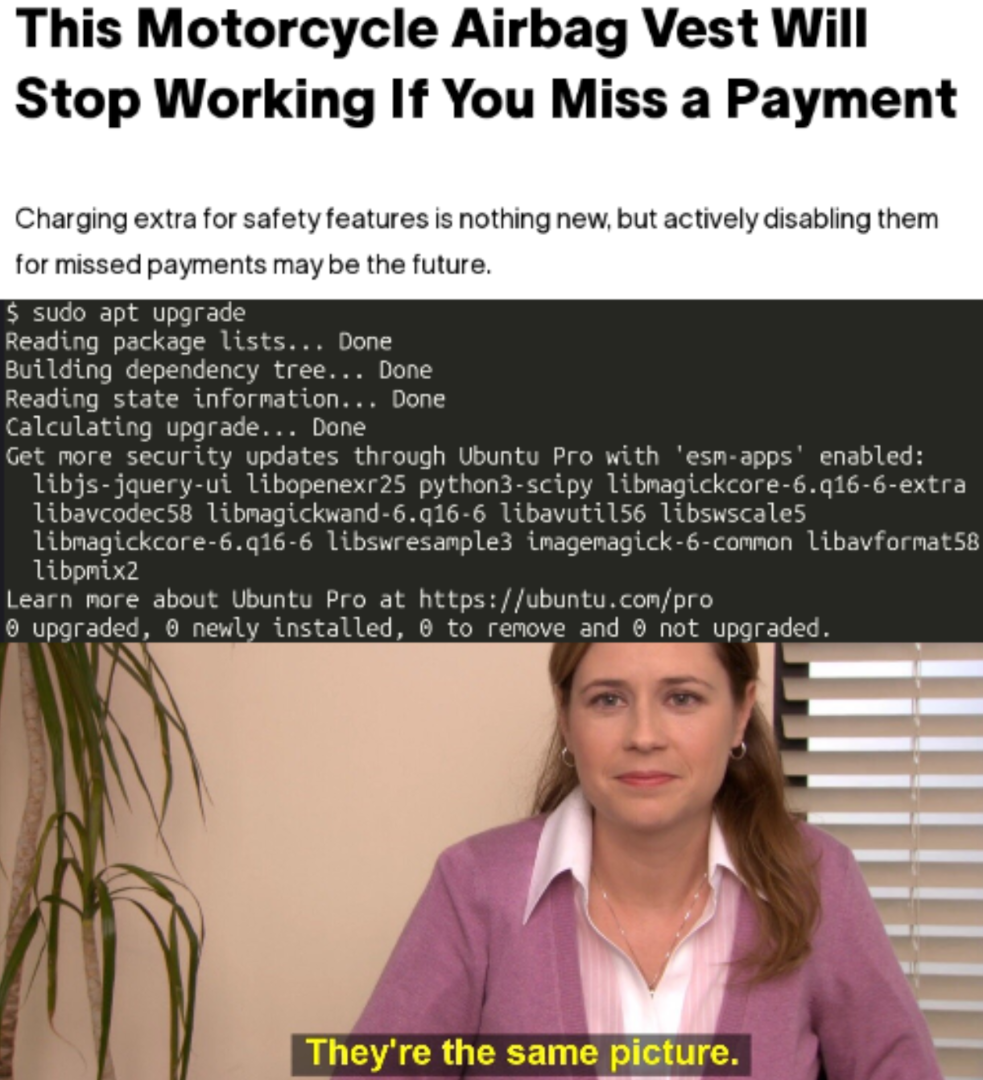
First screenshot is from here.

Second screenshot is from me updating an Ubuntu 22.04 LTS system today.

Post title is from https://web.archive.org/web/20130223104643/https://help.ubuntu.com/10.04/about-ubuntu/C/about-ubuntu-name.html via https://en.wikipedia.org/wiki/Ubuntu_philosophy
 

via (original source unknown)
view more: ‹ prev next ›