keiko

joined 3 years ago
[–] keiko@fedia.io 1 points 7 minutes ago

Complicated setup and configuration to best thing to have?

I kinda think so, yeah. Qubes OS is top-tier in my eyes, and is pretty sophisticated (and quite complicated to understand when first starting out with it). From there, Whonix is wonderful (qubes-whonix is the perfect combo), and the other advanced distros are known for their extensive customizibility/configurability (which also makes them pretty complex/complicated). With great power comes great responsibility (to read and learn lots of stuff).

Then tiers that just say arch, debian.

There's not much to differentiate those distros in my view. Lots of flavours of arch and debian. I see them all similarly. Some users might prefer something like pearOS for an arch-based distro which is styled very similarly to apple operating systems, while some other users might prefer an arch distro like CachyOS which is meant to be optimally performant. But I still see those as comparably arch. Similar with the debian row. The ones which sprout from those rows are the ones which are optimized for security, otherwise they're all just flavours.

And maximally mini

lol yeah ^^' See, one of the things is that all of the text has to fit and line up pretty much perfectly, and I'd wanted to keep that one simple and (hopefully) easy to understand. Also, idk, it felt kinda cute. "maximally mini" idk lol

[–] keiko@fedia.io 1 points 17 minutes ago

My plan was to eventually make a repo after eventually setting up my own server (if i can ever accopmlish such a þing), but I will probably share þe svg versions here soon-ish (i need to double-check the original code for all the svg files used to make sure i re-add any/all attribution that was stripped out when making this thing). (oh and also, i was 2 pixels in þickness off, with þe group at þe very bottom)

[–] keiko@fedia.io 1 points 21 minutes ago

tyvm ❤️ What had started as a random fun project ended up sucking me in, and I spent more and more time researching different distros to see how þey compared in my eyes. þe systemd age-verification controversy is what had caused me to consider it a worþwhile goal to be free from reliance on systemd, and I slowly discovered lots of such distros. I do really hope Qubes OS can move in þat direction eventually. And yes, I realize my views of þese distros is probably very different from þe views of most oþers. Neverþeless, random conversation-starting content <3

[–] keiko@fedia.io 2 points 40 minutes ago

tyvm ❤️ I credit my unmedicated psychological disorders and the emptiness of my life which is sometimes randomly filled by projects like this that captivate me and don't really matter.

[–] keiko@fedia.io 2 points 44 minutes ago (2 children)
[–] keiko@fedia.io 1 points 52 minutes ago

Yes, the google connectivity is the connectivity stuff like dns and ntp, and yes I think it lacks Play Services and MicroG by default. I just don't like google connectivity built-in without an easy way to disable it. That's why I like that projects like /e/OS exist as an easy way for people to get degoogled android (though I prefer linux over android for myself).

[–] keiko@fedia.io 4 points 56 minutes ago (1 children)

suicide or suicidality? subtle difference. "my suicide" suggests failed attempts of the past, whereas "my suicidality" suggests potential for a successful attempt yet-to-come. or it could be intentionally ambiguous to represent both. relatable <3

[–] keiko@fedia.io 1 points 1 hour ago

LinageOS is not degoogled and will connect to google unless properly firewalled, which afaik cannot be done properly on-device. Waydroid is basically a containerized LineageOS which can at least be firewalled from the host os, but that's sub-optimal, which is why I have it one notch above LineageOS.

[–] keiko@fedia.io 1 points 1 hour ago (2 children)

LinageOS is not degoogled and will connect to google unless properly firewalled, which afaik cannot be done properly on-device. Waydroid is basically a containerized LineageOS which can at least be firewalled from the host os, but that's sub-optimal, which is why I have it one notch above LineageOS.

[–] keiko@fedia.io 2 points 1 hour ago

I did include a full list in the original post, organized by row, and placed in a spoilered text-box thing. I had decided not to include the names under the logos because I would have obsessed so much longer if I'd have attempted to do that. As it is, I'd been obsessing with this project for several weeks. Why? idk

[–] keiko@fedia.io 5 points 2 hours ago

neither do i :p

Person 1: "Do you know how cool Qubes OS is?" Person 2: "You are getting more obnoxious than arch users." Person 1: "I have some arch qubes too." Person 2: "I know, you told me multiple times."

[–] keiko@fedia.io 2 points 2 hours ago

Oh, but you have variants of Ubuntu. Do you have them, because there are technically not part of Canonical?

Yeah, that's my reasoning for including them and for the row they occupy.

For me, CloneZilla is a sysadmin tool. Wouldn't have guessed that they don't have a SVG version of their logo.

I'm not saying they don't have an svg logo, just that I hadn't come across it when searching for as many operating system logos as I could find. I had started with distros I've used and then worked my way through popular distros. Clonezilla had seemed more of a tool and less of a distro so I hadn't spent much time searching for its logo. If i were to add it, I'd probably want it in the debian row, which is already quite full.


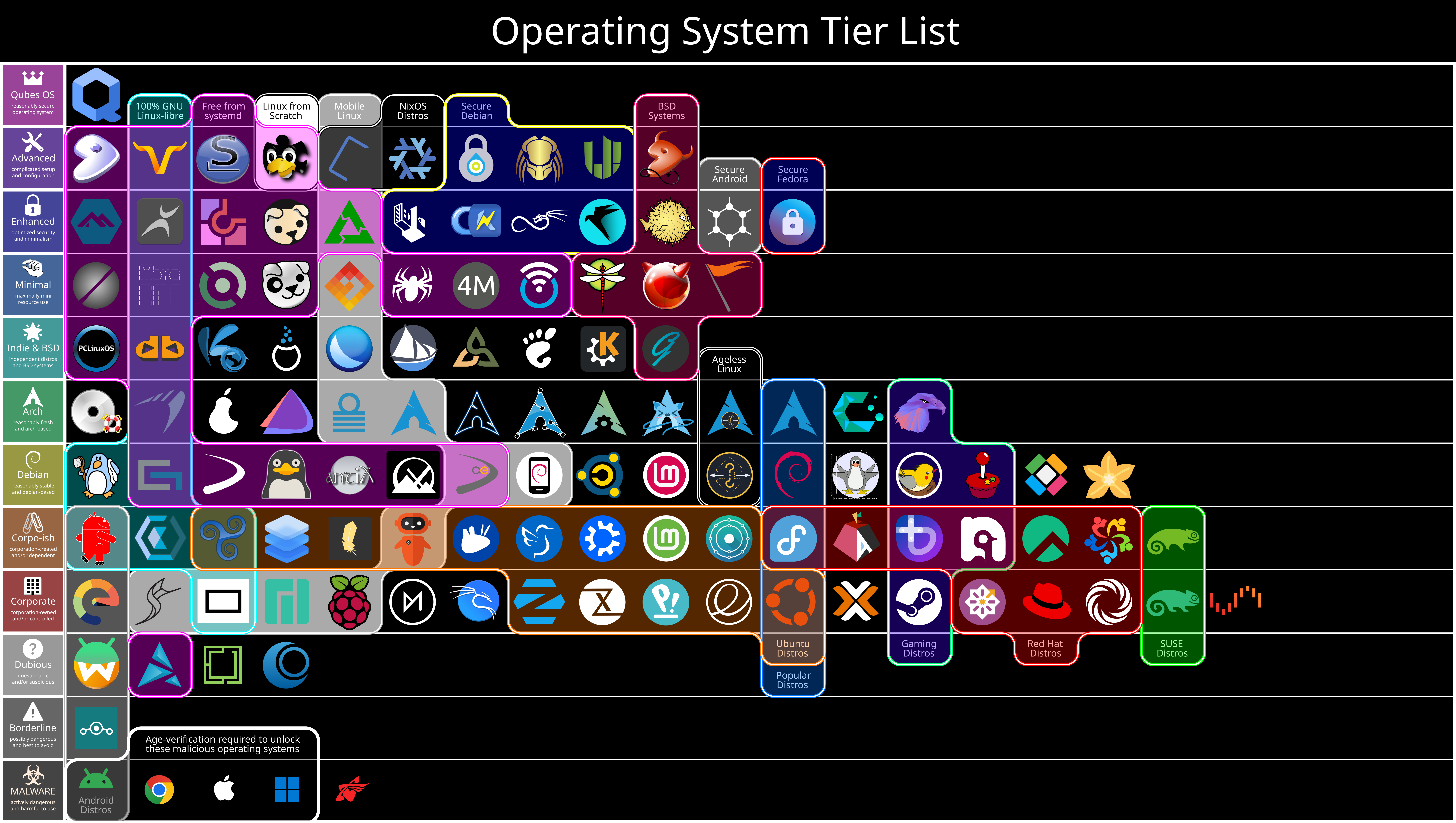
So I saw political compass memes a while ago and started making one, but then I started taking it too seriously and eventually turned it into a tier list. Idk if it makes sense to share it here, but idk where else to share such a thing. I also made a browser tier list, but idk where to share that either.

This whole thing is a png export of a pure svg image. For some of the logos, I had to make them either from scratch or by using gimp and inkscape to convert a png into an svg (imperfect but good enough).

Hopefully this is all formatted properly.

OS Tier ListS-Tier (reasonably secure operating system):

  • Qubes OS

Advanced (complicated setup and configuration):

  • Gentoo Linux
  • Guix System
  • Slackware Linux
  • Linux From Scratch (LFS)
  • Mobile NixOS
  • NixOS
  • Whonix
  • Predator-OS
  • Linux Kodachi
  • Gentoo FreeBSD

Enhanced (optimized security and minimalism):

  • Alpine Linux
  • Hyperbola GNU/Linux-libre
  • Chimera Linux
  • EasyOS
  • postmarketOS
  • Tails
  • Kicksecure
  • NetHydra
  • ParrotOS
  • OpenBSD
  • GrapheneOS
  • Secureblue

Minimal (maximally mini resource use):

  • Tiny Core Linux
  • LibreCMC
  • Void Linux
  • Puppy Linux
  • AsteroidOS
  • Slitaz
  • 4MLinux
  • OpenWrt
  • DragonFly BSD
  • FreeBSD
  • NetBSD

Indie & BSD (independent distros and BSD systems):

  • PCLinuxOS
  • Dynebolic
  • KaOS
  • Mageia
  • LuneOS
  • Solus
  • AerynOS
  • GNOME OS
  • KDE Linux
  • GhostBSD

Arch (reasonably fresh and arch-based):

  • SystemRescue
  • Parabola GNU/Linux-libre
  • pearOS
  • EndeavourOS
  • Nemo Mobile
  • Arch Linux Arm
  • BlackArch Linux
  • Archhurd
  • Archcraft
  • Nyarch
  • Ageless Arch
  • Arch Linux
  • CachyOS
  • Garuda Linux

Debian (reasonably stable and debian-based):

  • Flora Linux-libre
  • Genuen
  • Devuan GNU+Linux
  • Loc-OS
  • antiX
  • MX Linux
  • Maemo Leste
  • Mobian
  • Emmabuntüs
  • Linux Mint Debian Edition (LMDE)
  • Ageless Linux
  • Debian
  • KNOPPIX
  • PikaOS Linux
  • RetroPie
  • LibreElec
  • Vanilla OS

Corpo-ish (corporation-created and/or dependent):

  • Replicant
  • Uruk GNU/Linux-libre
  • Trisquel GNU/Linux
  • AnduinOS
  • Linux Lite
  • UBports
  • Xubuntu
  • Lubuntu
  • Kubuntu
  • Linux Mint
  • KDE neon
  • Fedora
  • Asahi Linux
  • Bazzite
  • Nobara Linux
  • Rocky Linux
  • AlmaLinux
  • openSUSE

Corporate (corporation-owned and/or controlled):

  • /e/OS
  • Sailfish OS
  • PureOS
  • Manjaro Linux
  • Raspberry Pi OS
  • OSMC
  • Kali Linux
  • Zorin OS
  • Tuxedo OS
  • Pop!_OS
  • elementary OS
  • Ubuntu
  • Proxmox
  • SteamOS
  • CentOS Stream
  • Red Hat Enterprise Linux (RHEL)
  • CloudLinux OS
  • SUSE Linux Enterprise
  • Unraid

Dubious (questionable and/or suspicious):

  • Waydroid
  • Artix Linux
  • Omarchy
  • OpenMandriva

Borderline (possibly dangerous and best to avoid):

  • LineageOS

MALWARE (actively dangerous and harmful to use):

  • android
  • chromeOS
  • Apple Operating Systems (macOS, iOS, etc.)
  • Windows
  • Red Star OS
view more: next ›