this post was submitted on 06 Jun 2026
1311 points (98.4% liked)
Political Memes
11931 readers
2154 users here now
Welcome to politcal memes!
These are our rules:
1) Be civil
Jokes are okay, but don’t intentionally harass or disturb any member of our community. Sexism, racism and bigotry are not allowed. Good faith argumentation only. No posts discouraging people to vote or shaming people for voting.
2) No misinformation
Don’t post any intentional misinformation. When asked by mods, provide sources for any claims you make.
3) Posts should be memes
Random pictures do not qualify as memes. Relevance to politics is required.
4) No bots, spam or self-promotion
Follow instance rules, ask for your bot to be allowed on this community.
5) No AI generated content.
Content posted must not be created by AI with the intent to mimic the style of existing images
founded 3 years ago
MODERATORS
you are viewing a single comment's thread
view the rest of the comments
/uj
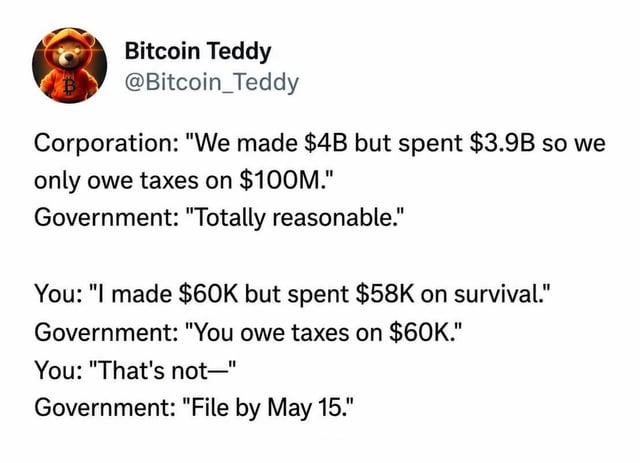
The "money spent on survival" is the standard deduction and deductions in general. Deductions are viewed as if you never made that money in the first place. Whether standard deduction should be larger is another question.
True, and broadly deductions, but deductions are very different.
For example, owning my house, the taxes do not care that I pay insurance and property tax on it. They do not care if I have to spend $10,000 on HVAC because it went out.
However, if I own a house that I rent out, I can deduct all of that. And this is ignoring the standard deduction, you can deduct this stuff on top of the standard deduction.
I think this is the sort of BS, that a business can wave away most any expense but a private citizen just has to suck it up.
Yeah, because $16k is enough to survive.
A diet of nothing but rice and beans, living in a rented room in a garage, and dumpster diving for all the remaining necessities and you can almost live in California!
I'm on a fixed income and cannot live in California. I do thanks to parents giving me some intergenerational wealth early by paying my $2k-ish rent for me. (They're in their eighties and still alive.)
What timeframe is that $2k-ish rent?
New York? A half month in a leaky but somehow airtight corrugated metal shed, no air conditioning and a communal bathroom that also happens to be the yard your "bungalow" is in
Ohio? 6 months in a house that used to be someones starter home but they added more to the house, cut it in half, and now charge the same if not more rent for each half than someone paid for the original mortgage. You will be harassed for the rent because "i have to pay the mortgage" but it was paid off over a decade ago. The landlord takes multiple vacations, out of the country, every year. Conveniently around storms and bad weather, so when your roof falls in there's nothing they can do for two weeks.
That doesn’t answer my question at all and you’re not the person I asked.
OP even acknowledged this and this shit is still top reply. Dumb fucks everywhere.
You're right, of course. But I also think it would open up a giant loophole for the wealthy. A car is essential for survival! A three million dollar car? ... A 15,000sqft house?
Of course, they could set reasonable limits. But when was the last time congress was reasonable?
Corporations can tell the government what their deduction is, the government tells normal humans what their deduction is.
The government tells you what the standard deduction is. You don't have to claim that standard deduction. You can specifically itemize the deductions you wish the claim instead. You can claim considerably more than the standard, if you so choose.
Whether we should be able to claim more and whether the standard deduction is large enough are different questions.
You can say that you would like to claim more, but the government sure as hell isn't going to let you claim survival expenses like that. Go ahead and try to claim your rent. Unless you are using part of your rental for business purposes (not just living) they'll just tell you to get fucked and pay the taxes anyway.
So yes, you can put it on the paperwork. But actually claim it? Almost certainly not.
It certainly depends on what you're actually paying, yes. It's very unlikely that your deductible expenses will be greater than the standard deduction. But, it is certainly possible under certain (rare) conditions.
Rent alone here is higher than the basic personal amount, let alone any other necessities. And I'm in one of the cheapest cities in Canada for rental housing.
Which is to say, almost every single tax paying person in the entire country would be getting more than the basic personal amount (Canada's version of the standard deduction in the US) if we were allowed to claim basic necessities. And not by a small amount.
All you are telling me is that "rent" isn't a deductible expense.
None of that changes the fact that if you have more deductible expenses than the standard deduction, you can claim greater than the standard deduction.
The standard deduction is ~$16,000 for a single person. Medical expenses are deductible. If they spend $32,000 in a hospital stay, they would be better off itemizing the whole deduction rather than taking only the standard deduction.
Of course, they aren't obligated to itemize. They could just take the standard deduction and be done with it. That choice is available to them, foolish as it is.
Educational expenses are deductible. They can choose to spend much more than $16000 on school expenses, claiming much more than the standard deduction.
Again, what should and should not qualify as deductible, and the size of the standard deduction are completely separate questions.
You are missing the point that for a business everything is a deduction and for an individual almost nothing counts as an itemized deduction.
It is a lie to say "you could itemize" when the IRS specifically does not allow W2 employees to itemize rent, transportation, food, and entertainment.
You're getting hung up on the categories. You don't have to be just a W2 worker for someone else's business. You can also be a contractor: you can be a business yourself. No, you can't deduct that part of your subsistence you use for W2 employment or personal use. But, you can put yourself on the clock for your own business, and that business can deduct everything that any other business can do.
If you're not deducting that part of your home, utilities, vehicles, electronics, tools, and equipment that you use for various business purposes, you're doing something very wrong.
Your business doesn't have to actually turn a profit. Legally, you have to try to turn some kind of profit, but you don't have to actually succeed. 30% of home-based businesses never do.
"If you’re not deducting that part of your home, utilities, vehicles, electronics, tools, and equipment that you use for various business purposes, you’re doing something very wrong."
Ok, but why should it have to be for business purposes to be deductible? Why does a landlord get to deduct the same exact expenses a private homeowner cannot?
I haven't addressed that issue. I've addressed the fairness issue. If you can present your expenses as business expenses, you should. If the only reason you can't is because you aren't presenting yourself as a business, present yourself as a business and take the deductions.
That's the OP argument! You can't say, employee taxes aren't unfair, just be an employer. It's ridiculous! You have only restated the OP's claim: businesses can deduct virtually everything and employees can deduct virtually nothing.
Sigh.
Forget about all of your W2 earnings for a moment. Forget about the 8.5 hours a day you spend working for someone else. Forget about your bi-weekly paycheck. None of that stuff matters here, or to the IRS.
Forget all of that, hold an annual garage sale.
Now, you're a business. You get to deduct the poster board you purchase advertising your sale. You get to deduct the balloons and price stickers.
You also get to deduct that part of your rent or mortgage that you spend on the garage where you keep your inventory. That is now your "warehouse", which is part of your (non-employment) business. How about your attic? The attic is part of your home. You pay mortgage/rent/taxes on that part of your home right along with every other part. I doubt you use it for anything but storage anyway. Put the crap in your attic on your lawn with a price tag once a year, and you get to deduct the part of your housing payment that goes toward your attic.
You get to deduct the cost of acquiring your inventory. That is also a business expense.
Spend an afternoon in a lawnchair while your neighbors look through your ~~junk~~ inventory, and you get to claim thousands of dollars in business expenses.
If you're worried the IRS might take issue with you if you only do this once a year, you can put up an ebay, etsy, craigslist, or marketplace listing, and it becomes a year-round operation. You are now an online retailer, and your annual garage sale is just a clearance sale for that business. If you're still not sure, you can file paperwork with the state to be able to collect sales tax (and deduct the filing fee as a business expense).
I absolutely can, and it's not ridiculous at all. The problem you're having here is that you think you need to be Walmart in order to call yourself a business. You don't. You think you need to generate a profit to be a business. You don't. (You do need to try to generate a profit. But, very few businesses are actually able to successfully generate a profit, and yours doesn't need to be successful either. "Trying" is enough.) I am quite confident that many of the things you do in your day-to-day life can already be categorized as "business", or could be considered a business with slight tweaks. You are legally entitled to count expenditures on those activities as deductible business expenses.
You keep trying to change the argument from the lack of fairness in tax policy to a discussion of how you can dodge taxes by becoming a business.
Yes by becoming a business you can dodge taxes like other businesses. That's not the argument.
OP: "rent is high" YOU: "no its not, just buy a house" OP: "that's not what I said" YOU: "You're not listening, here are tips to buy a house cheaply."
You buying a house cheap doesn't change that the OP said rent is high. Becoming a business doesn't change the tax policy allows deductions for businesses that employees don't get.
And your "garage sale tip" is bullshit of the highest order. If you've done it, you are lucky you haven't been audited. You can't deduct on a loss every year without being classified as a hobby. If you are holding a garage sale, you aren't earning a profit- that's why its not taxable. You selling a 20 year old $10 beanie baby for 25 cents is a loss and you don't have to pay taxes on that 25 cents.
I completely agree. It is bullshit of the highest order. There is a special IRS term for "bullshit of the highest order". That term is "business".
If I had done that, and I was audited, and the IRS had a problem with it. I'd owe what I would have owed anyway. Maybe with a small penalty.
How many companies do you need me to name, and how many years do they need to show losses? You certainly can show several consecutive years of losses. You'd be hard pressed to find a company that hasn't shown many consecutive years of losses. Lack of profit doesn't mean a business is unsuccessful. It means they paid out their vendors and workers and creditors a bit more than they brought in.
And why do you assume you will always show losses? Why do you assume you won't find a profitable niche in the process? The only requirement the IRS needs to classify you as a business is the fact that you don't make an assumption like that. That assumption is what makes it a hobby. Don't make it, and you're a business.
Small penalty is when you make a mistake. Gigantic deductions with no income would have them charging you with tax fraud. The lawyer fees to defend yourself would be worse than the penalties.
Companies like Amazon showed losses a decade because they had income from investors. So they had income, it was only that the "business" side of the business was unprofitable.
You can't get away with deducting your mortgage as a business express from a unprofitable garage sale. Certainly not year after year.
So we are back to, "just buy a house if you can't afford rent."
Tax avoidance schemes isn't the argument.
Tax fraud would be claiming deductions for expenses that were never incurred. The expense of "rent" was incurred. The expense of "posterboard" was incurred. The expense of "balloons" was incurred. Using your attic for something other than storing items you retail in your online store and garage sale would turn your claim into fraud, but I never suggested you should do anything like that. That you attempted to sell everything in your attic indicates it was not used for personal use. They may not allow you to claim it as a business expense, but they can't argue fraud unless you used it for personal use despite claiming business. So don't do that. Don't use it for personal use when you claim it as a business use.
I didn't say deduct your entire mortgage. You can't do that, unless you use the entire home exclusively for business. But you certainly can deduct a part of your mortgage, a part proportional to the amount of your house you use exclusively for business.
What are you talking about? That doesn't make any sense whatsoever, and it certainly doesn't arise from my arguments.
Look, you're entering into this from the assumption that I'm suggesting you defraud the government. That is completely untrue. What I am saying is that "business" is a much broader category than you seem to think. A garage sale can certainly be a business activity. Re-selling merchandise online can certainly be a business activity. There is no explicitly defined line on how many business activities you need to perform, nor a explicit time period in which you need to perform them in order to consider yourself a business. As long as you approach it with the intention of (eventually) becoming profitable - even if you can't figure out how to do that right now - it is a business, and you are entitled to claim it as such.
It is the epitome of foolishness to conduct business activities without declaring them to be "business".
We're literally talking about corporations being "people" but able to deduct things that people can't. If corporations are people, and they can deduct rent (they can) why can't everyone else.
You've completely lost the plot mate. You can't say THE LITERAL QUESTION WE ARE TALKING ABOUT is a separate question, wtf lol
A large part of my house is used exclusively for business purposes. I deduct that part.
I don't do this myself, but businesses are allowed to compensate workers with, in part, housing. Your home-based business could deduct the housing it provides to workers, including yourself.
Overall, the general shape of the system makes sense.
Everybody receives services provided by the government, so everybody should help pay for that government. The FDA tests to make sure food and drugs are safe. The NHTSA makes sure cars and highways are safe. And, of course, the big one, the military protecting the country from invasion. The standard deduction exists so that people only have to start paying taxes once they get their basic needs met.
Of course, I know that in the real world it's much more complicated than that. The US military might actually make Americans less safe by getting involved in all kinds of conflicts overseas. The terrorist attacks of Sept. 11th would probably never have attacked if the US had a defence-only military. The FDA is being corrupted by an antivax nutjob, and so-on. But, the theory of everybody contributing taxes to pay for things provided for the common good makes sense. The real standard deduction is absurdly low and almost nobody can actually fully meet their needs with that minimal amount.
It also makes sense in the abstract that corporations don't pay taxes on money that doesn't get distributed to the owners. If a Mom and Pop grocery store is doing really well and Mom and Pop pay themselves huge salaries, they pay personal income tax on those salaries. If they arrange to do it through corporate dividends or something, then it's the corporation that pays taxes. On the other hand, if the store is doing really well and they want to expand, it makes sense that the government not tax them based on their revenues if they're re-investing those revenues into the business. If they're investing the money into making a bigger, better store to serve their community rather than simply taking the money out as profits into Mom's purse and Pop's wallet that's good for the community. Also, if Mom and Pop made $400k in revenue but spent $390k on expenses, and that includes the wages of some cashiers, it's probably unreasonable to tax the revenue before the employees are even paid.
The problem is really in the various loopholes and ways corporations claim to be re-investing the money. We wouldn't want Mom and Pop's grocery store to be unable to expand because they're taxed before they can even invest. On the other hand if Pop buys a Porsche SUV under the store's name and claims it's a grocery delivery van, that's not fair. Other people have to buy their SUVs with after-tax money. In theory, if Pop is caught claiming that SUV as a business expense but using it for purely personal purposes, the IRS will go after him. But, of course, the reality is that companies get away with that kind of thing all the time.
I think part of the complaint here is based in the reality that corporations get away with lots of things, and that taxes are a real burden on the poor and middle class. On the other hand, I think there's also a lot of financial illiteracy where people really have no idea how the taxation system works. They just see ragebait on social media and get angry because something about it seems unfair.
Person: $16k for food is part of standard deduction. No deduction for car or rent if you are an employee.
Corporation (which is legally treated as a person): $150k for food for one party. $150k for CEO's Mercedes. $500k for condo for ceo to use when visiting.
Pretty sure that's the point
I'm pretty sure you are correct.
That’s the thing. Corporations report their own deductions, but individuals have to follow existing law, when there’s a high variance among necessary spending
You can also report your own deductions if you itemize. If your income is low, the standard deduction is probably just significantly bigger than your itemized deductions.
Legal deductions are extremely limited if you are an employee. You can't deduct your car, your rent, or the big screen TV you bought.
For employers, anything that didn't end up in the bank at the end of the year is a deduction.
You definitely want to be operating some sort of home business on the side, even if you are employed. You don't get to count employment-related expenses, but you do get to count expenses attributable to that separate business.
Also, not true. You can deduct any expense needed for work. Uniform, supplies, food if you're required to eat on the clock, car payments if you're a delivery driver, all deductible. You can deduct a haircut if your employer has a grooming policy.
It's just not worth it for most people. You need to save receipts and be able to prove it was a job-related expense, and if you do something wrong, you could be charged with tax fraud.
Commuting to and from the job is an expense needed for work. You can claim that part of your non-reimbursed travel expenses to temporary work sites that exceed your normal commute, but you can't claim your normal commute.
You cannot deduct your commuting expenses. Not gas. Not bus fare. Not parking.
Uniform items are deductible only of you don't get a uniform allowance.
If they give you a $50/yr boot allowance, you don't get to claim your $300 Red Wings. If you buy your own tools but your employer provides a (shitty, shared) set, you don't get to deduct your tools.
But, this is all about W2 employment. In practice, the overwhelming majority of expenses you incur in the process of W2 employment are not actually deductible, because your employer is already taking the deduction.
But, if you are running your own home business, your usual workplace is your home, and you can claim transportation expenses anywhere you need to go for that business. You can deduct the use of a part of your home. You can deduct part of your utilities, your wardrobe, your tools. Even if your home business is one of the 30% that are operated at a loss, you can deduct the expenses incurred while doing business, and offset a part of your W2 income.
People can report their own deductions, too. It's just not worth it for most people.
The problem is that the IRS "doesn't have the resources" to audit corporations and millionaires. They basically only audit small business owners.
Edit for sarcasm quotes
Even that though, you can only deduct part of your living expenses. There is no food deduction afaik, there is no deduction for insurance as far as I know.
Most of us also pay a much higher proportion of our income in sales taxes. Businesses are exempt from such taxes; they are only paid by the end user.
That's absolutely not true. Businesses pay sales taxes, too. Nonprofits/churches/etc are exempt, but otherwise, every transaction is taxed.
No, that's incorrect. I am very well aware of this. Businesses only have to pay sales taxes on purchases for which they are the end user. They'll pay sales taxes on their office supplies and services provided to the business. But manufacturers do not have to pay sales taxes on the raw materials they purchase. Retailers do not pay sales taxes on wholesale purchases they make for resale. Only the end-user pays the sales tax on a purchase.
I work with a couple vendors that do not collect sales tax at all. They only sell B2B, and they only sell to businesses who provide them with a sales tax exemption certificate.
What you are describing is more akin to Europe's VAT system. Still, under VAT, everyone in the chain pays VAT, and each vendor remits the collected VAT to the tax authority. But, the business-buyer reclaims that VAT from the tax authority if they are not the end-user of the purchased product. Everyone but the end user can reclaim their VAT payment.
Which is ass backwards. Audit those with the highest amounts and they made way more money. It's proven it worked that way until they cut funding for it
I'm pretty sure I read that auditing the wealthy is a huge profit center for the IRS, because they find people who aren't paying what's owed. Naturally conservatives (of any party) hate this and gut it whenever possible
Auditing in general is profitable, but it's mostly due to it being automated for people that aren't making 7 figures. Auditing the not absurdly wealthy is also generally a positive revenue. Auditing the extremely wealthy tends to not be a great net benefit as the costs of lawyers and court time outweighs the settlement check at the end. There's an argument to be made it's worth the cost to ensure the ultra wealthy do actually pay though.
It's billions of dollars of tax "avoidance", cheating, and simply not paying. Unfortunately, the wealthy who are calling the shots don't really want to pay millions for IRS lawyers
Yeah, if you look at the numbers it's obvious. But libertarians don't let facts get in the way of a good narrative.