this post was submitted on 20 Jul 2026
1239 points (99.4% liked)
Microblog Memes
11854 readers
2425 users here now
A place to share screenshots of Microblog posts, whether from Mastodon, tumblr, ~~Twitter~~ X, KBin, Threads or elsewhere.
Created as an evolution of White People Twitter and other tweet-capture subreddits.
RULES:
- Your post must be a screen capture of a microblog-type post that includes the UI of the site it came from, preferably also including the avatar and username of the original poster. Including relevant comments made to the original post is encouraged.
- Your post, included comments, or your title/comment should include some kind of commentary or remark on the subject of the screen capture. Your title must include at least one word relevant to your post.
- You are encouraged to provide a link back to the source of your screen capture in the body of your post.
- Current politics and news are allowed, but discouraged. There MUST be some kind of human commentary/reaction included (either by the original poster or you). Just news articles or headlines will be deleted.
- Doctored posts/images and AI are allowed, but discouraged. You MUST indicate this in your post (even if you didn't originally know). If an image is found to be fabricated or edited in any way and it is not properly labeled, it will be deleted.
- Absolutely no NSFL content.
- Be nice. Don't take anything personally. Take political debates to the appropriate communities. Take personal disagreements & arguments to private messages.
- No advertising, brand promotion, or guerrilla marketing.
RELATED COMMUNITIES:
founded 3 years ago
MODERATORS
you are viewing a single comment's thread
view the rest of the comments
view the rest of the comments
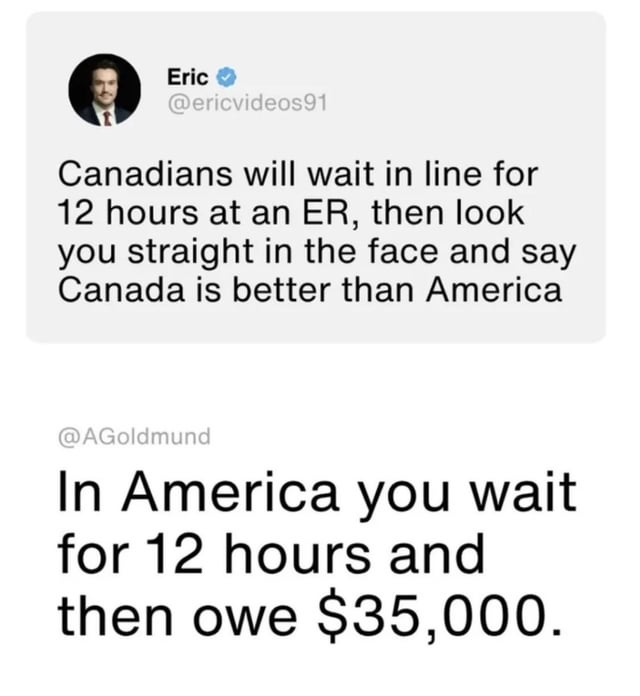
"Wasn't super expensive", " 24k", sorry what the actual fuck?
The worse part is that this is totally dependent on who your insurance is, and you don't know prices on anything until the bill shows up 3 months later. You or your doctor also might have to fight your insurance to prove a procedure is necessary, or that a medication needs to be covered. Most times you can expect your procedure to not be covered, so you have to tell the insurance company that yes, this is covered, here's why it was necessary (usually this first round of rejection is done via having an algorithm or ML setup "review" the case).
You seemed to miss the part where he said the surgery wasn't all that expensive, it was the stay in the hospital that was.
In some sense the US system is more reflective of the "true" cost of healthcare, just in the least humane way possible.
Take a country with "bad" socialized healthcare: Patient pays some percentage of visit cost, government pays the rest.
You break your leg: ambulance with two EMTs is $100/hr, 2 x-rays at $10/per, $30 in assorted bandages and plaster, and $150/hr for a doctor. Total patient cost: some percentage of $300.
The US system charges all those, but also reflects the cost of those things existing and being available as reflected in patient usage. The socialized system sees the ambulance ride as distinct from when the community needs a new ambulance, or the cost of having EMTs available 24/7/365.
Likewise, you get charged not just for the bandaging, but the cost of the person who brought the bandage to the nurse applying them, the cost of the person tracking the inventory, and the cost of the nurse isn't included in the medical care. Your room isn't charged as a room but as the room plus the services of everyone who keeps a hospital room ready to go.
A socialized system just happily says "of course a hospital needs skilled janitors and maintenance people, but only an idiot would call what they do patient care"
No one notices the cost of every hospital janitor and HVAC specialist in an entire country being divided amongst the entire tax base. You do when your share of the salary of all of them at your local hospital gets added to a bill addressed to you.
Our system is the way it is because otherwise no one pays for the pharmacist, and insurance caps things weirdly. Also, you have to multiply everything by 3 because the insurance company will refuse to pay anything above 1/3 of "list" price.
It may be outstandingly cruel, but it is ~~good~~ also terrible at providing cost transparency. Which is worthless to everyone except accountants at work paying for healthcare.
So yeah. That's cheap, and the WTF goes deeper than most people can imagine.
Don't all of those costs have a profit counted into them? I've always thought that a socialized system is incentivized to be as cheap as possible, to have as few "customers" as possible, which means that the whole system, from education to taxation, should make policies that improve people's health, to make sure they need to use the hospital as rarely as possible.
Yes, but that's socialism and therefore bad.
/S just in case
Edit: actually, it's lost potential revenue which is even worse.
That depends a lot on the medical system. Some systems target profit, but some are non-profits, affiliated with universities or other arrangements that make sense for a medical system.
The city I live in has two main hospitals. One is run by a for profit corporation. The other was a non-profit that got government funding to cover the difference because they were the main "ER as only healthcare" hospital in the area, since the other was built on the rural side of the suburbs and this one was in the middle of the population center. Then they got bought by, of all things, another non-profit operated by a public university. The first non-profit also owned a for-profit insurance company and a fitness center. I think the disposition of those is an ongoing legal question, since the university also owns an insurance company and there's some weird conflict of interest interplay.
It's a clusterfuck but the redeeming side is that the hospitals are actually extremely good.
Having at some point or another used all three systems I can say that the prices were basically the same. The staff all like that they can transfer patients to the university easier, but dislike the new parking system.
Yeah it's actually a serious problem how many hospitals in the US are non profits run by religious organizations. Like, your local ER has a decent chance of being owned by the catholic church and you won't know until you need medical care they don't approve of.
Yup, it's preposterously cruddy. I like my random bits of research so I happen to know the ownership details of my local institutions, but that's far from common. And even if it was, it's not like you even get a choice if you're in need, if you even had options to choose from.
The previous non-profit, the one that got purchased by the university, started as a charitable outreach from a local women's group in the 1890s. Then a business man donated some land and money and they made a proper hospital.
The Catholic "hospital" was a ghoulish dive that was basically a small ER with a few other beds and offices. Eventually they got bought out by the womens group hospital and turned into a sleep medicine and medical imaging annex.
I'm just realizing we have three hospitals which feels like a lot for a city this size.
Yes and, insurance companies spread out their costs among all their enrollees, whether or not they have to use those hospital services and equipment, in the form of premiums. (And of course they add on the cost of their CEO's yacht, etc. because evil.) So that's how they "save you" a portion of the billed amount.
But having so many uninsured people, whether healthy or sick, that aren't even part of the system hurts everyone.
Which is why we need to eliminate the insurance racket, make healthcare universal and pay for it through taxes, perhaps a sliding scale based on net worth as long as I'm fantasizing.