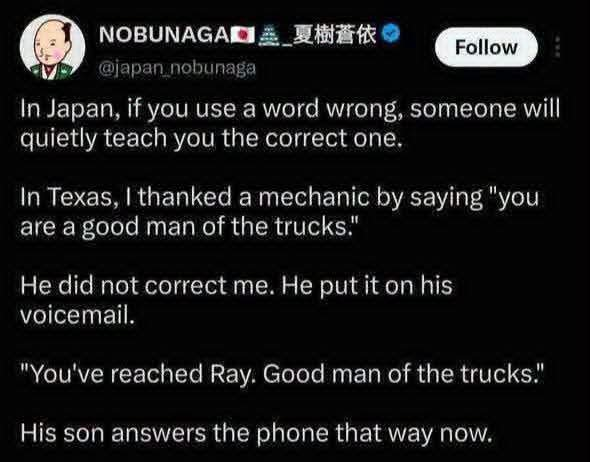
this post was submitted on 20 Sep 2026
1313 points (98.7% liked)
Microblog Memes
12610 readers
1927 users here now
A place to share screenshots of Microblog posts, whether from Mastodon, tumblr, ~~Twitter~~ X, KBin, Threads or elsewhere.
Created as an evolution of White People Twitter and other tweet-capture subreddits.
RULES:
- Your post must be a screen capture of a microblog-type post that includes the UI of the site it came from, preferably also including the avatar and username of the original poster. Including relevant comments made to the original post is encouraged.
- Your post, included comments, or your title/comment should include some kind of commentary or remark on the subject of the screen capture. Your title must include at least one word relevant to your post.
- You are encouraged to provide a link back to the source of your screen capture in the body of your post.
- Current politics and news are allowed, but discouraged. There MUST be some kind of human commentary/reaction included (either by the original poster or you). Just news articles or headlines will be deleted.
- Doctored posts/images and AI are allowed, but discouraged. You MUST indicate this in your post (even if you didn't originally know). If an image is found to be fabricated or edited in any way and it is not properly labeled, it will be deleted.
- Absolutely no NSFL content.
- Be nice. Don't take anything personally. Take political debates to the appropriate communities. Take personal disagreements & arguments to private messages.
- No advertising, brand promotion, or guerrilla marketing.
RELATED COMMUNITIES:
founded 3 years ago
MODERATORS
you are viewing a single comment's thread
view the rest of the comments
view the rest of the comments
I have been saying it for years, English is a very informal and open language, have fun with it. Sky water is not technically a wrong way to refer to rain, liquid laundry soup is absolutely a sauce for your laundry, dish bricks, day star, the list goes on
I think this is one of the reasons why English (or it's descendants) will forever be the international language of trade. If it's not your first language, it's damn difficult to make yourself sound like a native speaker, but it's damn easy to make yourself understood.
Words ordering with grammar can be unimportant to being known.
On the flip side, a lot of other languages have retained structures which require a detailed knowing of grammar in part because they haven't needed to be learned by amateurs.
Mate we're all amateurs here. Unless you are being paid to learn languages
I'm not paid specifically to speak English, but I feel like meetings would go a lot longer without it
True, though I would personally count that as a bad thing. Purity of language, to me is irrelevant. That opinion may be coloured by the fact that I'm a native English speaker, and there hasn't been anything resembling purity in this language for thousands of years. To me, the point of language is open communication. Any impediment to that is a negative.
I lik your way of doyng byzness
They're talking about English, not Welsh
I just fixed your dumb spelling >:(
Here he is, fuckin get em
Whereas English has adopted so many idioms from other languages with different grammar that we're entirely comfortable with the exotic phrasing, or if it's ambiguous we make puns and/or poetry from it.
I speak several languages, most of which are Romance languages (such as French and Italian) which have a specific word order which pretty close to english (though adjective come after nouns rather than before, plus there are some additional verbal times though those are uncommon to use).
Amongst those I also speak Dutch and German, which have quite a different word order (though, curiously, Dutch from Belgium has a similar word order to French) and I constantly fuck it up (especially in German, which is the one of the two I speak worse) and the natives always understand me.
In my experience learning two of those languages just by living there (and with people that are learning my own native language), it's using the wrong words that confuses people, then using the wrong accent (mainly by putting the emphasis in the wrong syllable) and only as a far third is word order and even that only in specific cases such expressions (where it's the whole expression as is that has a meaning, rather the meaning being a composition of the meaning of the individual words in it).
In my experience there really is no special quality of the English language that makes it easier to understand when people use a wrong word order.
I think you're confusing a reasonably short period in recent history with "forever".
In History there were quite a lot of "international languages of trade" other than English. It seems to depend very much on which nations were the top empire of the age and because the last two top empires were English-speaking countries (first Britain, then after that the United States), the English language has been dominant as a second language for a over a century now, but before that the English language already existed in a form very similar to the modern form and yet it wasn't at all an "international language of trade" (in fact, at least in Europe, before English it was French that was the dominant language of trade).
I bet that the next "international language of trade" will be Chinese.
Laundry soup, yumm
I remember an interview with Lisa Kudrow in which she described her French boyfriend's failure to remember the English word for toes, and said they were foot fingers.
English: if the people you're talking to understand what you're saying, you're ok. Even if the people you're talking to don't understand what you're saying, you're still ok. Just be fancy with your words, and everyone will like it.
In french, that's really the name that is given to them, colloquially : doigts de pied (foot fingers)
The real term is orteils (toes)
They're really good at it, too. Sometimes it's even charming. For example, potatoes are "earth apples."
I wonder if the meaning of pomme was broader in Old French, like how meat (from mete) used to mean food in Old English.
Yes it was the case, broadly pomme meant fruit.
Originally tomatoes were called pommes d'amour. There is pommes de terre (potatoes) pommes de pin (pinecones). If we would translate literally pomme de pin it would give us pineapple.
There were also other fruits beginning with pomme originally but I can't seem to recall them.
Pomme comes from latin pomum which could be used for any fruit, apple specifically was malum.
I vaguely heard that ‘berry’ and iirc ‘apple’ were used the same way in English, one for small fruits and the other for larger ones.
It's the same in Dutch - "aardapple" - but using the Dutch words for earth and apple rather than the French ones.
And don't get me started on French numbering - for example 98 is "four twenties eigtheen".
One doesn't get it for one's own language because all the weird stuff is "normal" but when you're learning other languages you discovered they're all riddled with funny constructs like this (and then there are expressions, which are often hilarious - for example on of the Dutch expression for wasting time on small details literally translates to "fucking ants")
I knew someone who used the term "bird leaves" which I find hilarious.
Same in Russian: пальцы ног (fingers of the foot).
And in German, Dutch and Afrikaans (at least), we call gloves hand-shoes (Handschuhe / handschoenen / handskoene)
I would think gloves would be hand socks, but then I don't know what hand shoes would be.
kennings are great
https://en.wikipedia.org/wiki/Kenning
Apparently a lot of Old English poetry was written with ample use of kennings, e.g. ‘Beowulf’.
Not sure what a dish brick is, but yeah, the others make sense 👍
Edit: just figured it out: it's a Lego piece shaped like a dish
I was assuming one of these things: https://en.wikipedia.org/wiki/File:Detergent_tablet.jpg
I'd say it's a plate
Teeth shampoo
My kid calls them “nose holes”.
I think you're replying to the wrong comment, but I know what you mean - nostrils are called "Nasenlöcher" (nose-holes) in German.