this post was submitted on 16 Aug 2026
396 points (99.0% liked)
Political Memes
12364 readers
2450 users here now
Welcome to politcal memes!
These are our rules:
1) Be civil
Jokes are okay, but don’t intentionally harass or disturb any member of our community. Sexism, racism and bigotry are not allowed. Good faith argumentation only. No posts discouraging people to vote or shaming people for voting.
2) No misinformation
Don’t post any intentional misinformation. When asked by mods, provide sources for any claims you make.
3) Posts should be memes
Random pictures do not qualify as memes. Relevance to politics is required.
4) No bots, spam or self-promotion
Follow instance rules, ask for your bot to be allowed on this community.
5) No AI generated content.
Content posted must not be created by AI with the intent to mimic the style of existing images
founded 3 years ago
MODERATORS
you are viewing a single comment's thread
view the rest of the comments
view the rest of the comments
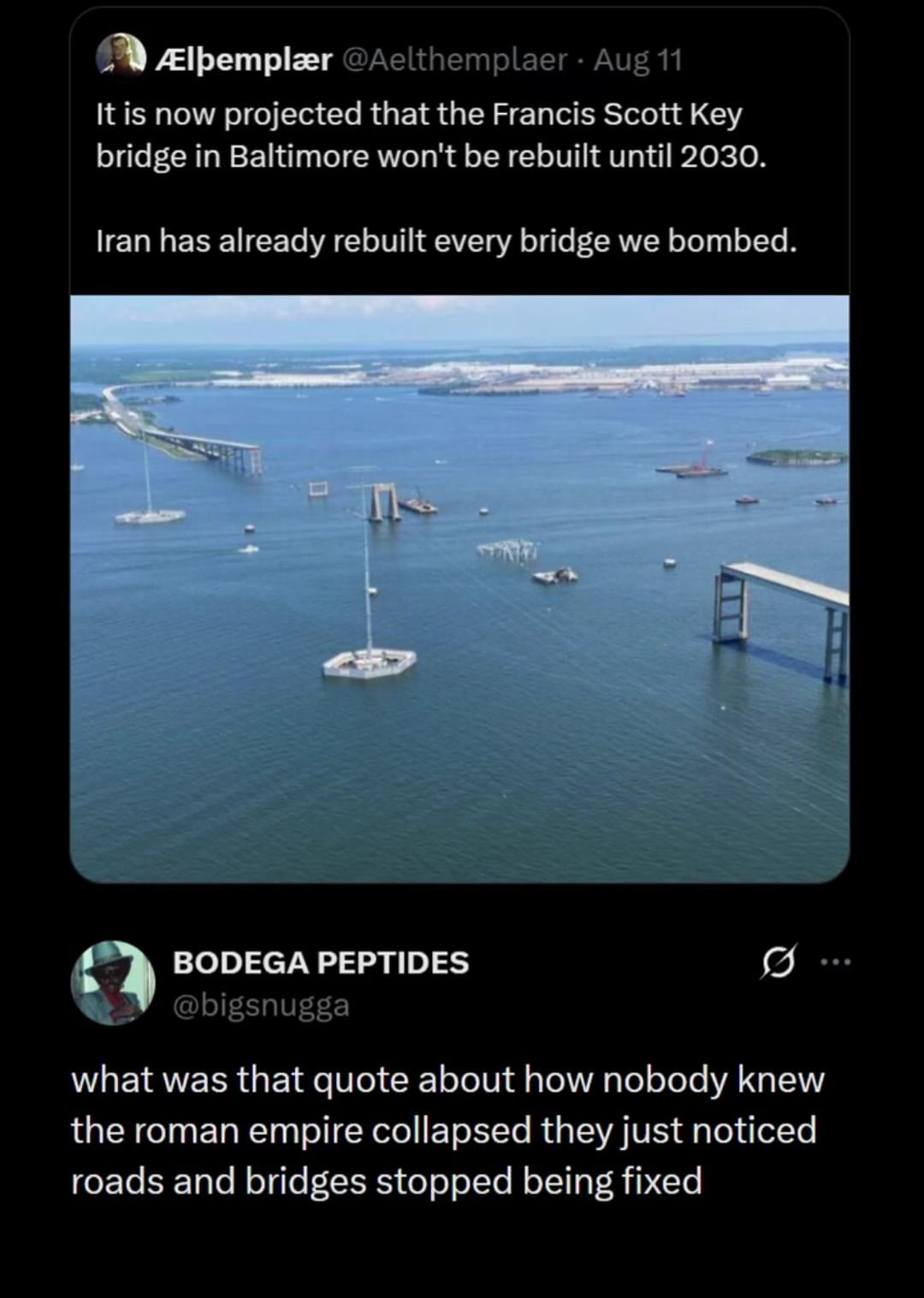
Yeah, it's not really a direct comparison. Bridges in Iran are generally badly damaged like this (real examples):
But the Francis Scott Key bridge is fully just gone for the entire load-bearing span and needs to be rebuilt.
That's pretty easy to fix. The bottom image just has a hole in the bridge deck. Clean up the hole, epoxy in some new rebar, build some forms, pour new concrete, and you're done.
The top image is worse, but it's still not as bad as it seems. Look closely at that bridge. That looks to be a bridge made of precast concrete. Look how the whole fallen span seems to have come down in one big piece. It's a very clean break.
When I say precast, I mean literally that. The beams for that bridge are not poured on site. They're made in a factory and trucked in. A precast concrete plant could have a whole yard full of beams just sitting there, ready to go. How you build such a bridge:
In a bridge like this, often the only part that is poured in place is the bridge deck. To fix the bottom bridge, you would remove any debris, clean up the edges, drop in some new beams, build some forms, and cast a new bridge deck.
And what I'm describing is just typical precast concrete bridges. I'm describing what you can do even when you haven't optimized your whole bridge construction sector for easy repairability. But Iran has been preparing for a US attack for a generation. The reason the US's decapitation strike failed to cause a regime collapse was because Iran isn't some tin pot dictatorship lead by one brutal despot. It's an advanced nation that's built its governmental system from the ground up with survivability in mind. There was an elaborate continuity of government plan in place, and as the US and Israel assassinated Iranian leadership, the conveyor belt just moved folks up to replace those killed. It's a modern day governmental version of the ancient Immortals. Iran's even granted a lot of their military forces a high degree of autonomy. There are a whole bunch of missile crews hiding in underground bases with standing orders to launch at pre-chosen targets if they don't receive word from leadership after a certain amount of time. In short, Iran has gone to great lengths to make its government and military highly resilient to attack.
And if they did this for their government, why not their infrastructure? You can design bridges with quick repairability in mind. For example, you can standardize sizes as much as possible. Instead of custom designing everything, design your precast bridges to use only a small number of different beam sizes and standardized length. You tell your bridge engineers:
I have no idea what Iran is doing. But I do have a background in structural engineering. I've taken a literal course called "bridge design." If you asked me to design a nation's bridges to be extremely repairable, this is how I would do it. The piers are the hard part to replace, so you make those far, far stronger than they need to be. That way if a bomb blows off a chunk of a bridge pier, there's still plenty of capacity left. Everything else? You standardize the hell out of it and then mass produce and stockpile replacement parts. If you only allow six beam sections and 6 beam lengths, that means there will only be 36 types of beams used across all of your bridges. You can then produce and stockpile huge numbers of these beams, allowing extremely rapid repair after an attack.
We typically don't build bridges to this level of standardization. The problem with using few standard sizes is that you inevitably end up over-designing your bridge. You can't design the perfect custom cross-section to carry your loads with the absolute minimum amount of material possible. So your bridges end up heavier and more expensive than they could otherwise be. But if you're willing to pay a bit more for a much, much more resilient transportation system, standardization can accomplish this.
Again, no idea if Iran is actually doing this. But considering the lengths they've gone to make their whole regime resilient to attack, it wouldn't be unreasonable to assume they've applied the same philosophy to their physical infrastructure. You don't try to build an indestructible bridge. You just make your bridges easy to repair instead. If you do it right, repairing a bridge will be far cheaper than dropping a bomb on one.
Sure but if you took the billions and billions spent on attacking Iran and instead rebuilt the bridge it could have been done by now.
Straightfowardly, no, it couldn't be. Bridge construction on this scale isn't just a matter of throwing money or people at the problem. Like the old saw that says you can't get nine women to make a baby in one month, a 1200' span takes time. Foundations have to be built below water, piers have to be formed and given time to achieve design concrete strength, and each bridge segment has to be completed in sequence, including formwork, rebar, concrete pouring and setting, etc., in a careful sequence that keeps the cantilevered sections of the bridge in balance.
The US is no paragon of speedy infrastructure projects, but even in China cable-stayed concrete bridges are years-long projects. The Changtai Yangtze River Bridge, for instance, has spans similar to the Francis Scott Key bridge and it took fully 6 years from start of construction to completion, never mind design time.
this user bridges