this post was submitted on 03 Sep 2026
990 points (98.2% liked)
Lemmy Shitpost
41718 readers
3747 users here now
Welcome to Lemmy Shitpost. Here you can shitpost to your hearts content.
Anything and everything goes. Memes, Jokes, Vents and Banter. Though we still have to comply with lemmy.world instance rules. So behave!
Rules:
1. Be Respectful
Refrain from using harmful language pertaining to a protected characteristic: e.g. race, gender, sexuality, disability or religion.
Refrain from being argumentative when responding or commenting to posts/replies. Personal attacks are not welcome here.
...
2. No Illegal Content
Content that violates the law. Any post/comment found to be in breach of common law will be removed and given to the authorities if required.
That means:
-No promoting violence/threats against any individuals
-No CSA content or Revenge Porn
-No sharing private/personal information (Doxxing)
...
3. No Spam
Posting the same post, no matter the intent is against the rules.
-If you have posted content, please refrain from re-posting said content within this community.
-Do not spam posts with intent to harass, annoy, bully, advertise, scam or harm this community.
-No posting Scams/Advertisements/Phishing Links/IP Grabbers
-No Bots, Bots will be banned from the community.
...
4. No Porn/Explicit
Content
-Do not post explicit content. Lemmy.World is not the instance for NSFW content.
-Do not post Gore or Shock Content.
...
5. No Enciting Harassment,
Brigading, Doxxing or Witch Hunts
-Do not Brigade other Communities
-No calls to action against other communities/users within Lemmy or outside of Lemmy.
-No Witch Hunts against users/communities.
-No content that harasses members within or outside of the community.
...
6. NSFW should be behind NSFW tags.
-Content that is NSFW should be behind NSFW tags.
-Content that might be distressing should be kept behind NSFW tags.
...
If you see content that is a breach of the rules, please flag and report the comment and a moderator will take action where they can.
Also check out:
Partnered Communities:
1.Memes
10.LinuxMemes (Linux themed memes)
Reach out to
All communities included on the sidebar are to be made in compliance with the instance rules. Striker
founded 3 years ago
MODERATORS
you are viewing a single comment's thread
view the rest of the comments
view the rest of the comments
I've spent a lot of time traveling, been to close to 40 countries. A lot of times I had to get a visa. Once to get in Switzerland for two weeks I had to present a lease agreement from a friend there who welcomed me for few nights. Stack of papers I have to the embassy was a finger thick.
Wholeheartedly and fully wish this whole system to go burst in high flames. One of the fondest memories I have is the first time I came across Polish-Czech border without any controls when both countries joined the Schengen agreement. Or the other time when me and a bunch of friends were strolling in a park in Germany and casually strolled over a bridge into Poland. I did it, like, five times just to enjoy it.
People who are rooting for closed borders, territory wars, influence - are either not traveling or privileged enough to not see this. Fuck them. I'd rather have a better world for everyone than excellent for selected few.
Grew up in Texas, and back in the 80s it was very normal for kids to just hop into a car and drive south of the border for Spring Break. This was the most normal thing in the world for hundreds of thousands of teenagers and young adults.
And then national media realized they could make a lot of cheap news coverage by scandalizing the practice. So we got a slew of news stories, which became inflated with an even more over-dramatized series of books, tv shows, and movies, showing kids going across the border for drug use and rape and animal abuse and to dispose of dead bodies for the cartels and to get eaten alive by the Chupacabra. We got bombarded by a slew of media with a flashlight under the chin whispering "Oh, you think these kids are having fun? Well, what if the news threw a red filter over the images and used graphical effects to imply everyone was murdered?!"
Both the US and the Mexican police got more and more involved. The borders became militarized. You ended up with these obnoxious traffic situations, which really killed the appeal of any kind of vacationing. Also didn't help that a lot of the popular destinations got enclosed and privatized, for the benefit of a few insider luxury developers. The cost of a vacation exploded, as cruise lines and chain hotels and resorts took over the best spots. And now it's been fully Disney-fied, with a heavily demarcated entry and exit for tourists who are heavily discouraged from mingling with locals.
Shit fucking sucks, man.
Closed borders don't make things better for a selected few if they make the world those selected few live in shitty.
I've also travelled and that's why I want borders, at least for now.
We should definitely be working to raise people in the poorer parts of the world out of poverty. I've been to some developing countries, and life there is extremely hard. That's why so many of them want to move to a rich country where they can live a better life.
Yeah, as a rich westerner, borders are an annoyance. It's great going around Europe and going from the Netherlands to France without needing a passport or anything.
Having said that, in the Netherlands and France, and most other western countries, there is a great social safety net paid for by taxes that makes sure that everybody living in those countries can live a decent life. But, even Europe was put under stress by the fact that some countries in the EU have a GDP per capita that's half what it is in other places.
A fair number of people migrated to richer countries within the EU for a better life. Most found a job and worked. They contributed more to the countries than they received in benefits. Even then, that was hard on those richer countries because it displaced some of the lower-wage workers, or depressed their wages. Despite this, the EU has mostly held together, other than Brexit, and the majority of the UK now regrets Brexit.
The important thing to remember is that the EU vets members before allowing them in, and was slow to allow the poorer Eastern European countries to join.
If the world eliminated borders tomorrow, the richer western countries would be swamped by poorer people from developing countries seeking a better life. There's no way that the systems in those countries could cope.
The rich might love it. Suddenly there would be hundreds or thousands of people competing for the lowest paying jobs, allowing the bosses to offer the lowest possible wages, the worst possible working conditions, etc. The ultra-rich business owners could get rid of unions and get local workers for next to nothing.
For the slightly less rich, the professional class, it wouldn't be too bad. Their jobs are protected. You need to pass the bar to be a lawyer. You need to do a residency to become a doctor. Their professional associations would continue to do the work necessary so that say a doctor in Nigeria didn't have their credentials recognized in the west.
The less wealthy you are, the less protected you would be. For someone whose job doesn't require any kind of diploma, certificate or degree, there would be no protection. They'd be competing with every unskilled person who came into the country seeking opportunities.
Even if you personally think that chaos is a small price to pay for a more fair world, a lot of people don't. The rise of far-right and fascist movements in the west is a direct result of increasing immigration. If borders were eliminated, not only would there be a lot more far-right voters, there would probably be violent clashes, even mass slaughters.
A lot of people hate globalization, but it has resulted in raising a lot of people in developing countries out of extreme poverty. It has done that mainly by taking wealth and power away from the poorest people in richer countries by shipping their jobs overseas. That part sucks. But, at least a lot of people in developing countries are no longer in danger of dying if they have a bad few weeks.
Programs like USAID were a better way of doing some of the same things. These were often subsidies for US farmers whose produce was then just donated or sold extremely cheaply to developing countries. There were of course problems with this system too. Often the "farmers" receiving the subsidies were rich corporations. But, it did raise the floor for some of the worst-off people in the world.
If we can continue to find ways to help people in developing countries, we should do that. Hopefully we can find a better way to do it than we've done in the past. But, even a less-than-ideal solution does help. Eventually, we may be able to reach a point at which we can remove borders without resulting in a mass migration that overwhelms the systems of the richer countries.
Your way too long and easily compactable post is a good summary why I'm in support of going full throttle on investment in neighboring countries until their standards of living are up to par.
My post was way too long because it goes against the popular sentiment. If you agree with the popular sentiment, you can afford to have a short post. If you disagree and keep it short, people will downvote you for the things you didn't mention, or will accuse you of not considering X.
Anyhow, I'm in favour of investing in neighbouring countries, or just donating to them. There are problems with donating some things like food. It helps keep people alive, but it also means farmers take a hit because they're competing with free. But, it's hard to argue when people need food or they'll die. Donating training and skills development is a better path. I know someone who works at an NGO that works with local NGOs to train their leadership to be more effective. I think that's one of the best things I've heard of for helping other countries because it just makes the people living there more effective at what they do. But, it's not a quick process.
I've also travelled a lot, and while visa stuff can be a nightmare, this also sounds like it's coming from a super selfish reasoning. As if a democratically elected government representing people in a certain place should have no right to its own sovereignty so that YOU don't have to deal with paperwork?
What's funny is the exact scenario you all want already exists in Sub-Saharan Africa. Borders effectively don't exist at all for anyone willing to get off the bus, walk 50 meters into the bush, then 200 meters forward and back to the road. I've accidentally crossed several borders dozens of times.
But then when it comes to countries that struggle to find work for their own people, they also get flooded by people from places where no government functions at all. Specifically Nigerians in South Africa and Ghana. Legally present, and subject to xenophobic attacks because there no hope for them in Nigeria because it's a hot mess.
So... That's the ideal situation? And people can't leave that open border situation fast enough because the places that are stable are flooded by people fleeing instability.
Honestly, I'm asking, how is it supposed to work without literally magic being involved?
Fuck that. Everyone is my people.
Exactly, sick of the fuck you got mine mentality. There is enough in the world to go around for everyone, it's the uneven distribution and monetization of basic resources that makes it so some people in some countries starve.
So many if the world's woes today come from people vying for money, and for land and resources to...make more money.
If someone is sick you treat them. If someone is hungry you feed them. If someone is thirsty you give them water. I don't care what nationality they are, what country they are from, what language they speak, what gender they are, what sexuality they are, what disability they have, if they are a human being they deserve basic dignity, respect, and basic needs. Borders are arbitrary.
Careful there. They nail people to trees for crazy talk like that.
Have you ever been to an intentional community that doesn't vet new members?
No. Because they don't last long. I'm down with the oneness of existence and beings. Most people aren't, though. Many people are a hot mess and don't know how to deal with themselves or others.
And I promise you that the vast majority of the world does not want you showing up there. For real, test this by moving to rural Texas, or a Mormons-only area of Arizona, or Cairo, or rural DRC without cultural entree or any value provided to a suspicious community and see how that goes. Yes, people might chill out after months or years of you proving not a threat, but as a species, we're pretty paranoid.
I've not met that level of hostility in my travels. But I also never moved to bumblefuck nowhere. I'm guessing if people have never left their town, having people come into the town is a big deal.
Hostility isn't the right word. It's more just wary suspicion of an outsider. Which can easily and quickly escalate. But in small towns, it can without an outsider as a scapegoat.
Generally, you want someone to host you and provide some sort of cultural landing pad. Even as a tourist if you're only there to look at stuff.
I don't have solutions you need, but it doesn't prohibit me from thinking about the world where they exist. Or, I don't know, speaking about it in Lemmy.
Ok, but I'm really asking. How is it supposed to work? Why doesn't it work in practice?
Everyone who talks about some world with no borders seems to have some idea in mind, as if it's some .ml instance FAQ or something.
I mean, "democratically elected" does a lot of heavy lifting in countries that are choked out by fascist governance and fear-mongering media. "Sovereignty" also has a weird way of being used to weaponize self-determination into surveillance-state policing and xenophobic policy.
Why is it that a French citizen traveling to Germany or Spain is considered benign, but a Libyan citizen traveling to Germany or Spain is considered part of a "flood" that has some kind of existential threat to the locals? Why does Libya's dogshit government get raised as a reason why this Libyan visitor can't stay at my hotel or eat at my restaurant or work in my office?
Does being born in Country A stain someone's soul in a way that makes them incompatible with Country B?
You don't need magic to not have borders. If anything, you need a certain degree of magic to rigidly enforce borders. You need mass surveillance to track the identities of everyone entering and leaving your country. You need to engineer increasingly complex systems of identification, digital fingerprinting, financial controls, regulation on business and social activities, and prohibitions enforcement pursuant to a constantly shifting web of sanctions. You need an enormous body of labor to manage these rules and enforce them. You need prisons to hold all the trespassers. You sprawling bureaucracies to figure out who is "legal" and to change the legal status in a timely manner.
None of this shit works as intended. Legal residents routinely get harassed because records aren't properly maintained and distributed. Illegal residents slip through blind spots in the system. Black market trade grows faster than the regulated trade, because there's a larger profit margin in it. Legal business activity suffocates under the higher costs of compliance.
You ask how no-borders are supposed to work? I'd say, incredibly easily! Do nothing. Boom! You've achieved your goal.
I ask you how closed-borders are supposed to work? You're going to spend several lifetimes and untold fortunes trying to achieve this fantasy.
Sure, but since we're talking about hypothetical and fictional situations, I'm asking why a not real place that actually does democracy well and isn't dragging a legacy of being shitty behind it allowed to manage its own affairs and territory under this "no borders" idea.
And you're dodging the question I've asked, which is open borders in practice are a mess.
Uhh.... you do know the EU exists, right? Germany, Spain and France all have treaties in place under the EU and EEC that say they have freedom of movement, labor, and ownership of property among each other's countries as EU citizens. People from Libya aren't EU citizens, so laws granting transitive rights between EU member countries don't include Libya or anyone from Libya as Libya isn't part of the EU. If Libya joined the EU, then they would.
Plus, have you not seen recent complaints from Italians and Portuguese that they're being overrun with other Europeans and Americans anyway? How many Brits learned the hard way what Brexit meant when they lost residency in Spain?
You also seem to forget that Europe used to have hard borders. French people used to need permission to go to Spain, and vice versa. Spanish farmers, some possibly still alive today, needed special letters to tend to fields in France back in the 1960s.
Not at all, but why does someone being a human give them a right to go anywhere and do anything?
It also seems like no one has thought out the true dangers of economic imperialism with no borders or governments. Holy shit, you really trust social media and advertising to be left unchecked? A lot of peple would 100% move to the Wal-Mart corporate town and condos. That's also exactly how you get things like the insane Broligarchy Network State stuff. Highly developed pockets of society that rampantly exert force on neighbors to extract resources. You know, like people used to do to each other during the era of early history and pre-history.
A number of Latin American countries have very loose and friendly immigration policies. Argentina and Paraguay are the most notable. Idk if you'd say they "do democracy well". That's a real subjective criteria.
We've got a wealth of political philosophy and ethics debates that help answer that question, from John Stuart Mill to Lea Ypi who can answer that question better than I can.
But a better question might be, why wouldn't they?
Why would I trust the owners of social media and advertising companies to be the gatekeepers?
People already move to the Walmart Corporate Towns, in large part because Walmart dictates what criticism it will tolerate and what opposition it will face.
People screaming about corporate fascism today wanted to put Walmart Board Member Hillary Clinton in charge of the whole country not ten years ago.
First off, I want to thank you for engaging on this in a reasonable and respectful way. This is a touchy subject, and I'm honestly curious how people that talk about it think it should work. Doesn't mean I agree with the conclusions, but that doesn't mean I can't appreciate and respect your time and energy here. Thank you.
Right, but I'm not asking about their democratic structures. I'm saying with all the open, and open-ish borders, what actually happens? Do people from Peru and Ecuador typically go to Brazil for work? OK, well, so is that constant draining of talent good for Peru and Ecuador? Economic migration is usually a one-way street for decades at a time.
Another good example is Bulgaria and Croatia joining the EU. There's already a lot of migration from the Balkans into western Europe, and as soon as free movement was allowed, both places saw huge migrations of young people. Bulgaria is genuinely having a demographics crisis right now, and because it's only a bunch of old Boomers left, they're doing a bunch of typical Boomer things, like being extra conservative. Which isn't to say that people should be forced to stay put, but that in every instance of people having low barriers to movement, there's a losing side. And then the free, or even low-cost movement only makes it harder to fix the problems that made people leave in the first place.
And Lea Ypi is a great example, ironically, of someone who is brilliant having opportunity to move to study in Italy and sort of proving her own point wrong in a sense that she's not some Albanian drug dealer. Though I don't think that's relevant here, as the opportunity sought her out in a sense. Though, I would say that Albania is by far its own special case. Tons of Albanians have a personal ethnic pride and intentionally move back to Albania and Kosovo specifically to make the place better. It seems fairly family-oriented, as even their Eurovision songs very often feature "don't disappoint mom" lyrics.
And I wasn't saying that companies would be gatekeepers, I mean abusers. Unfettered abusers.
Really depends on economic conditions in the various territories. If you look at the US-Mexico border between the 20th and 21st centuries, a lot of the migration was entirely seasonal at first. Mexican laborers would move north during the planting and harvesting seasons, then go back down south during the winter. Only after restrictions on cross border travel tightened did we see people permanently relocating. And that was largely because every attempt to cross the border carried an increased cost and a host of new bureaucratic difficulties.
I don't know a ton about the Argentinian economy relative to its neighboring states, so I can't speak to the long term economic impact of loose immigration policy. But it has historically been one of the stronger South American state economies - second only to Brazil - with a GDP/capita third in line behind Chile and Uruguay. Hard to say they're suffering because of dramatic inflows or outflows of people, at least relative to their neighbors. But obviously there's a lot more at play than just immigration.
Peru and Ecuador aren't nearly as rich as Argentina, so - if anything - people are migrating into Argentina rather than out.
What you're describing is mass displacement due to a stark shift in economic policy brought on by the post-Soviet Shock Doctrine. FFS, Bulgaria went from the 16th strongest economy in the world to the mid-50s practically overnight.
I don't consider this exodus of young people a bad thing. It was a pressure release valve. A large number of young people kettled into a country with a collapsing economy could have just as easily ended up like Serbia and Bosnia, with an endless series of retaliatory genocides as rival ethnic groups play tug-of-war over scarce resources. Or like Turkiye, which has become a bottleneck in between Europe and the Middle East, where refugees simply pile up in camps and die by the hundreds. Or any of the North African countries, like Libya or Tunisia or Syria, where people in tiny boats attempt to (illegally) paddle their way across the Mediterranean and drown.
The prospect of a Bulgarian family legally and safely picking up, moving to Greece or Romania, finding a stable job, and reestablishing their fortunes doesn't seem frightening by comparison. Not even if it means the country's interior is hollowed out for a time. Bulgarians may return, as the state of affairs in Bulgaria adjusts and the political climate moderates. Or they may not, as they re-identify with their new home countries.
I might argue that the Shock Doctrine of the 90s/00s was horrible policy. And stripping the wiring out of the old Soviet Republics to prove, once and for all, that communism doesn't work was a bad long-term economic plan for Europe. But I consider the freedom of movement afforded by the EU to be the least-bad thing that came out of their induction into the bloc.
I don't recall anything in Ypi's works suggesting that people who move out of Albania are all drug dealers. She strongly critiques the Cold War Soviet Policy of strict immigration controls, state censorship, and over-policing. And she uses the recollections of herself, her family, and her neighbors to argue the virtues of a free and open society, unconstrained by rigid ideological constraints or militarized borders.
That's full consistent with her own life story. I'm not sure how you could argue otherwise.
Power corrupts. As soon as you establish gates, you need gatekeepers. And who else is going to man these gates if not the agents of the socio-economic elites?
In the US, that's the Waltons (among others). They have a significant financial interest in constraining immigration - both internationally and domestically - in order to put downward wage pressure on workers and control capital flows.
The Waltons abuse border controls and the criminal justice system that surrounds it more than any coyote or drug smuggler.
I think there is a disconnect here between us in terms of academic, data-only understanding and real lived experience. To suggest that Bulgarians are moving to Romania is wild. Most southern Slavs head for Germany and Switzerland, specifically because their economies are stronger, and there's a critical mass of slavs there already, so there's community. The Balkans have so much baggage that Bulgarians in Greece staying longer than summer holidays is laughable.
Which is to say that simply throwing "post-Soviet Syndrome" out there as a catch-all misses a lot of depth. Albania, Bulgaria, and Yugoslavia all had differing styles of socialism. Albania's was North Korea-style paranoid. They had a jobs program to build hundreds of thousands of cement bunkers because of a persistent fear that Yugoslavia would invade. It was breathtaking paranoia. I know a guy that was a kid near the Yugo border and tuned in his radio to a Yugo station - his parents genuinely thought they'd get sent to the gulag farms. Bulgaria was in the middle, and Tito liberalized Yugoslavia's economy to the point that it pissed off the USSR enough that he had to dodge an assassination attempt. Which meant that Yugoslavia's economy was thriving, and with another Slavic-speaking country next door, a lot of Yugoslavs would go to Bulgaria to exploit the disparity. The whistful ways old Yugoslavs talk about it sort of funny, and explains why Bulgaria is the way it is today. So Bulgaria had a relatively easy transition out of Socialism because they remained intact. Serbia, Slovenia, and Croatia all did well. Then Kosovo and Bosnia were trashed, and Macedonia just sort of the poor kid on the block, is too small to really do much other than get jostled around between its neighbors. Right now, Croatia is doing relatively well, and joining the EU took a decade of transition, but now they're a net recipient of immigrants. The non-EU Slavic Balkan countries empty out to staff Croatian restaurants each summer. Seriously, people take 3 months of leave without pay from office jobs to go wait tables in Croatia and make better money, then come home.
Albania had a terrible time transitioning out of socialism because of how closed off they were. A pyramid scheme collapsed the government because, and this is what every Albanian has ever told me about it, no one knew any better. The forced ignorance of capitalism made it seem like magic. Everyone genuinely thought pyramid schemes were how things worked. It's a fascinating history.
Speaking of Albania, I mean more that Lea Ypi's stance is that there's no "bad" or "good" migrants, or useful vs. useless. Which I appreciate from a human rights standpoint, but as a "good" immigrant that has empathy for fellow Albanians who are a slim minority of migrants, but are "bad" people in general, it muddies the waters in terms of practical application of her philosophy. I'm generally not super critical of Albania's corruption and organized crime within Albania simply because in the post-soviet era, it was closer to a Yakuza-style mafia that actually brought a fair bit of stability when the government itself was just some dudes trying to figure things out and hoping for the best. Less so for Serbia, but at some point it raises the question of legitimacy of governments is one thing, but then Albanian and wider Balkan organized crime isn't kind and nice and concerned about human rights. There's a lot of human trafficking and casinos and generally negative things wrapped up in there where it's a struggle for an African-style Western style government vs. an almost traditional government structure.
Why? As you rightly said, power corrupts. And the organized crime element that used to bring stability held a lot of power they don't want to give up. And the organized crime element also makes huge use of immigration as well.
Speaking of which, I think the larger issue today is that information sharing makes it easy for places to actually get flooded because of the speed with which rumors fly. There's a lot of trafficking on social media that rides on this exact effect. It's exactly the same thing about why some doughnut shop or whatever suddenly has a line down the block for mediocre doughnuts. There's more people, and more communication infrastructure, so migration patterns don't shift in long-term patterns, it's a quick turn over months.
Case in point, the low-information environments of The Grapes of Wrath and the movie El Norte. Both are tragic migration tales about the horrors of exploitation awaiting migrants at the end of a torrent of humans. Trafficking and undocumented migration patterns take advantage of this and exploit exactly the same way they always have, regardless of how complicit the state might be on the other side. Instead, today, it's organized. I once had a taxi driver in Istanbul tell me, in detail, about how his friend wanted to go to the States, so he flew to Mexico and paid a coyote, and now he's living somewhere in the midwest that he couldn't recall exactly, and he's miserable. Which is the same story I've heard from tons of African migrants, trying to explain to their families why they're not rich and can't send money home because everything is expensive and work is hard and pays nothing.
And to be clear, I'm not anti-immigration. And borders aren't a 100% detterent, they never have been. It's a barrier to entry that makes it take effort to get somewhere, be that an ocean or a mountain range or a desert or a river or a wall. Shit, how many people jumped the Berlin Wall to escape the East? Thousands - maybe tens of thousands? I'm not sure, but given the option of just crossing the border without a challenge, 90% of East Berlin would have emptied out into the West, and then what?
The part that I don't think you're really considering is that a borderless, and stateless world would feed capitalism and build it into a beast that only sci-fi novels have even bothered to imagine. Private security forces, private industry, private cities, all surrounded by townships and ghettos and slums of people dying to be exploited. Lagos is pretty much like that, and it's very much not pleasant. Children who are starving selling food they can't afford to eat themselves on packed highways. Until you see something like this in real life, I'm sure it's possible to think that it will work itself out, and that governments and laws and economics and money are objective evils. My friend, people do this to each other freely, regardless of the system in place.
Removing barriers that slow down the intensity of exploitation in some places sounds like the worst possible idea in the world to me. That's what I don't get about the no borders, no state crowd. You're desperate for a world that allows full capitalistic exploitation of anyone and everyone, and you're all just so sure of yourselves that it'll work and have to ignore so many examples of it being a genuine source of human misery. Then get pissed when people bring up that people are the problem, not borders as a concept.
But hey, I doubt I'll convince you of anything here. Again, I kind of doubt you've even read any of this and just sort of skim the first few words of each paragraph. Write the word quebapi if you've actually taken the time to read any of this. Or don't, maybe you're just an instance of an ageny on a botfarm in Malaysia and you'll go back and forth on this forever.
Most people I know that want an end to borders also want the end of government.
If people are struggling to survive but there are no jobs to be found, it's because the work that needs to be done isn't profitable. The work needs to be done to benefit society, but the ruling class demands that all work must be profitable.
Idk about that. The line I've always seen is that most people want a system which protects-but-does-not-bind. And what they recoil at is a system that binds-but-does-not-protect.
I want the border to be frictionless for me. But I don't want the border to be frictionless for people I don't like.
And therein lies the rub: if their government doesn't like you, the border then binds you but does not protect you. Borders exist because it projects power onto people within, and gives arbitrary rules for entry without. If you want truly free movement, you can't have projections of power
Okay, but that's just why this is the most important election of our lives and you need to turn out to vote or we'll be under the boot of the vile fascist-communist government of the Other Party That Doesn't Like Me.
I mean, that's a very narrow perspective. Borders exist as a compromise between neighboring governments, indicating where one set of legal codes ends and another begins.
Free movement is power projection. It's just projection by the people (and their attendant organizations and ideologies) doing the moving.
The whole neoliberal One Big Global Market wet dream was about projecting the power of Western financial and regulatory authorities around the globe. Open Borders can be as much about projecting power as closed ones. And whether you believe that's good or bad really hinges on whether you believe you're aligned with the people doing the power projection.
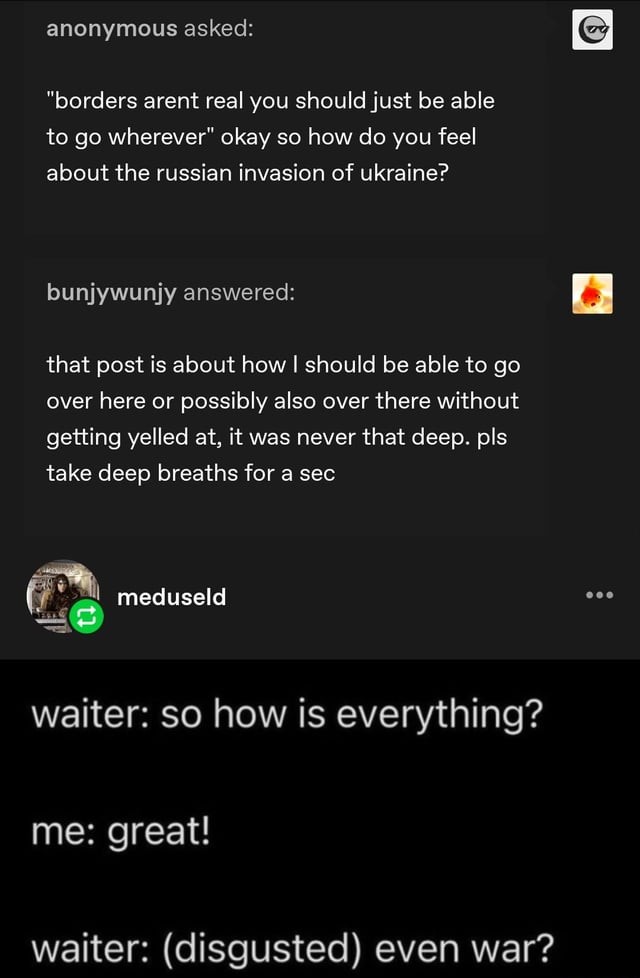
You absolutely could describe the Russian invasion of Ukraine (or the US invasion of Iraq/Afghanistan/Libya/Syria) as a kind-of Open Borders policy under the Bush Doctrine. The borders are simply open to those with a big enough battering ram to kick through the door.
So, not exactly an unbiased same, eh?
Explain how the "ruling class" does this to a rural subsistence farming village in Burkina Faso or Mali or Ghana. I'd love to see you explain it.
There's no such thing as "unbiased". If you see something you think is unbiased, that thing just reflects your bias.
So here's the thing. I want an end to borders and government, but the reality is that these social constructs exist and are acted upon regardless of my political desires. Those subsistence farming villages are a part of geopolitical governments, so it impacts them based on how the ruling class interacts with their government. The IMF is a concoction from capitalists to project neo-colonial power on the Global South. To get a loan from the IMF, countries are literally required to privatize vast swaths of their public services and public property, they're required to loosen labor laws, and they need to open themselves up to foreign companies that extract their resources to make a profit that is not reinvested into that country.
Oof, tell me you've never been to one without telling me you've never been to one. These are people who depend entirely on rain-fed agriculture and other than roads to get between towns, have almost zero interaction with even local government, let alone national government. You're sort of inventing a story of people that don't exist to fit your narrative.
And I've sadly spent a lot of time dealing with IMF loan terms and conditions, and labor laws across Africa and Eastern Europe, and things like giving up land or public works are either not entirely accurate, or specific and individualized conditions based on what a country wants an IMF loan for in the first place, and it's often gross mismanagement that leads to things like that.
Here's an example: when I lived in a large coastal city in West Africa, the city water ran one day a week, on Sunday afternoons. Why? Because the Japanese government paid for and built a desalination plant that worked great for years. Then the local government demanded it be fully handed over to them, and within a year it was no longer working because someone's unqualified cousin was made manager and spent the entire budget on things other than the plant. So in a city of 2.5 million people, we had to dig a well and spend $8,000 on a water filtration system because otherwise I have to pay some guys once a week to bring a truck full of milky-white water they clearly pumped from a trash-filled stream 2km away. And so, sure enough, look who needs a loan to unfuck the desalination plant the last government fucked up? And why, exactly, do you think they won't loot the cash and let the same thing happen? Because that's typically the cycle that plays out for all sorts of things like this. It's why most state-owned power and telecom companies are a mess, it's why nearly every passenger railway is wothless when it does rarely and slowly run. And yet, it's not just the IMF, it's also China and the Afrexim Bank that also do this. Even other governments on the continent do this same stuff for each other!
And labor laws...a lot of post-colonial countries wrote themselves labor laws that are intended to make it expensive for foreigners to do business there. Which, hey, go for it, defend local production. It's more than labor laws that function that way, for the record. However, local labor laws are often entirely different for locals, and you wouldn't believe how badly wealthy locals treat poor locals. I once saw a gate open to a known local guy's fancy house, and an old lady in a housekeeper uniform was using a big hotel tile buffing machine - polishing the fucking driveway. A cement driveway. That's not colonialism, that's a fucking decision someone made to pay some old woman probably minimum wage to polish a driveway. And culturally, opulence as trappings of wealth is a thing, but I've never seen a senior traditional leader be so exploitative as that. Then again, I doubt you even read most of any of this.
You'll blame colonialism and international finance for everything and anything, and it's not entirely wrong some of the time. But holy shit, people have agency and make decisions, too. And tens of millions of people across Africa alone live lives entirely removed the effects of the IMF or national government, so you have to know when and where to apply blame to stay grounded in reality.
Generations of pillaging, murder, theft, slavery, pollution, and political meddling. Also the occasional genocide. Have you ever read a single history book about Africa that wasn’t written by a colonizer?
Funny, I've never actually read any history books about Africa written by a coloniser. I have done a translation of a local novel depicting the horrors of colonialism to get the perspective out there.
I'm deeply aware of colonialism, and I personally would love if the AU would take the bold step of undoing the Berlin Conference borders. However, that's part of why the existing borders are largely seen as immaterial with regard to human movement. When I try to drive a car across a border, I need letters and insurance and papers. When my friend drives his car across borders, he drives through a village and no one cares. It's two separate worlds at some level.
Still, you can't be like Trump and blame everything on the same Boogey man. There's plenty of African nations that did a descent job of shaking of colonialism. Yet the same problems remain. Shit, tell me why Ethiopia has these issues, having never been truly colonized.
You just did the “but what about war?” thing.
No, I did the "explain it to me, because it doesn't work in real life" thing.
This post and the one you’re responding to are basically restating the screenshot in the OP, and you’re the person who’s being unpleasant.
These laws harm more they help and you’ve provided several examples in your post, you just apparently don’t see them.
I'm genuinely asking how it's supposed to work. It's a real question.
I'm providing real life evidence that it's not so simple.
If exposing you to reality in hopes of a real answer and not just "uh, like, anarchy, I guess" or restating lofty quotes from Marx is "unpleasant" then that's not on me, friendo.